

What is your land ethic?
May 2026, 2nd year apprentice
When thinking about my land ethic the quote that kept coming up from Aldo Leopold’s “A Sand County Almanac” is “A thing is right when it tends to preserve the integrity,stability, and beauty of the biotic community, it is wrong when it tends otherwise.” My land ethic to me seems very black and white: I just want to do the right thing. I want to participate in regenerative ag as opposed to conventional because it preserves the biotic community. Of course I will never be perfect, I drive a car and take long showers and eat a protein bar every morning which is wrapped in plastic that just ultimately ends up in the landfill, but on the whole I am trying to do the right thing. It makes sense to me to try and preserve the biotic community while also still participating in the system that provides food to the larger community, all while being economically feasible.
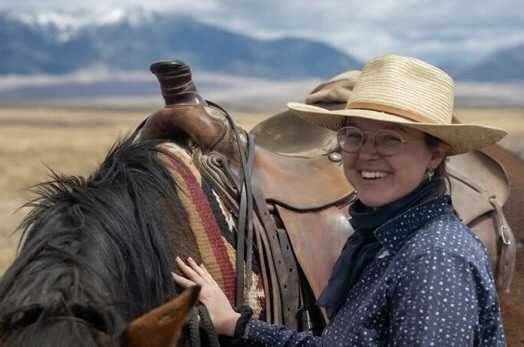
Another Aldo Leopold quote that stuck out to me when reading his description of land ethic says “All ethics so far evolved rest on a single premise that the individual is a member of a community of interdependent parts…..the land ethic simply enlarges the boundaries of the community to include soils, waters, plants, and animals, or collectively: the land.” Community has always been a driving force in my life, my earliest memories of being outside were playing with my neighborhood friends in our yards, making mud pies and potions. The outside in the dirt part was great, but it would have been nothing without those friends. My introduction to anything resembling agriculture was my weekly horse back riding lesson. I fell in love with horses because of the incredible relationship there is between a horse and a rider. There is a sense of partnership and trust I have never found anywhere else. That relationship is a sense of community. Now my idea of community has expanded to include all of those things Aldo Leopold mentions. Not only is it the farmers and ranchers and consumers, but the cattle and grass and water and on and on and on. All of these things matter and have a role in the community. All I want is to do the right thing by the community. That is all a land ethic is to me. Right now that looks like learning as much as I can about regenerative practices, water usage, grazing planning, native plants, etc. I wake up in the morning and feed our little bottle calf even though it is cold, and dark, and she head-butts really hard, because she’s a baby who is hungry and that is what you do for a member of your community. It includes getting up every day and moving the electric fence for the cows, and practicing low-stress livestock handling, dragging pastures to break up manure, and trailing cows down the road quietly from horseback. Trying to be a good member of the community here on the ranch.
As for how this informs my future, I know that I would like to remain involved in agriculture in some way, whether that is with agency work, a non-profit, an educational farm or ranch, or another option I haven’t thought of yet. But I think for me the most important thing is that I feel as though I am doing my part for the community as a whole, the human and non-human parts alike.
How did you get interested in agriculture? And what are you hoping to gain from your apprenticeship?
May 2025
I grew up in the Washington D.C. area and started taking riding lessons when I was about 9 years old. That was my first introduction into agriculture. My one riding lesson a week was time spent outside with animals, that grew into working after school and over summers at the barn. During those years I also took multiple visits to an organization called Heifer International’s working ranches where I first heard of regenerative agriculture. They were rotating plants in their garden, moving their chickens throughout their pastures, and intensively grazing sheep and goats as well as rotationally grazing their cattle. When I got to college I realized the classes I was interested in were ones where I was learning about conservation and the environment. I took classes in water resources and smart growth urban planning, among other things. After school I got a job as a wrangler in Colorado. This was my first time in the west and was my first introduction into ranching. The ranch I worked on was a regenerative cattle operation. I was working with guests and mostly focused on horses and riding but got enough of a taste for ranching to realize this could be the thing that combined all of my interests and passions. Animals, conservation, environmentalism, community, all of these things come together within regenerative agriculture.
Through this apprenticeship I am hoping to figure out what my niche in regenerative ag is. I have very limited experience in ag and want to figure out what makes me happiest and what I am most passionate about. Where can I put my talents to use and do the most good? I think learning as much as I can and making as many connections as I can over the course of this apprenticeship will only help me figure out where my interests are in this diverse field. I know this is a lofty goal and maybe I won’t have the answers at the end of the apprenticeship but I think it is an incredible step in the right direction.
Final Reflections
November 2025
The last 8 or so months of the New Agrarian Program have taught me so much about myself and what I want out of my life. I was re-reading my writing reflection from the beginning of the program while preparing to write this, in it I talked about wanting to figure out my passions and niche in regenerative agriculture. I mention wanting to figure out where I can best put my talents to use. It was interesting reading it back after so many months of not thinking about it because I feel as though I have made great strides towards that goal without even realizing it. I think that may be the most important thing for me that I am taking away from this first year with the NAP program, is a sense of direction and a goal to work towards, something I have not had for what feels like a long time.
I started this program excited to work on a site that was so diverse in their operation. I had never worked in the farming side of agriculture and was excited to learn how to operate machinery and learn about large scale farming. I had never worked with pigs or meat birds or run a farmers market stall, all things I had the opportunity to experience over the past 8 months. Part of the experience was learning that I did not particularly enjoy all of those things. While I am glad I can run an air drill and combine, I don’t think that dryland farming is my passion in life. But that is exactly what I wanted out of this experience, I tried it, I have the skill, and now my decisions about the future can be more informed.
The things I found myself most enjoying throughout the year were the parts that meant I was becoming a part of the larger community. Learning to recognize the cow herd, watching calves I’d seen being born grow up, and recognizing them every time I went to check water or drop mineral off. Some that I’d even worried if they were going to make it and bottle fed in the pasture, getting to watch them grow strong and gain independence from mom was an amazing feeling. That process of learning the cows and how they interacted with each other and the land, makes you a part of that community. Learning how to care for them and making sure that the cows and land are working together, and not against each other makes you an integral part of that community. In a more literal way, going to the farmers market every week made me more of a part of the community. Getting to know all of the other vendors, recognize regular customers, and build relationships brought me so much joy (and necessary human interaction). Being able to talk with people about regenerative farming and ranching practices has always been something I am passionate about and getting to do that every weekend brought a lot of meaning to my experience.
My take away from this season is that I don’t necessarily want to be in production agriculture for the rest of my life, but what I do know is that I always want to be involved in agriculture. My dream would be to get involved in natural resources, and work for an organization that works alongside farmers and ranchers to steward the land. This experience can only help me prepare for that, I will have been where those farmers and ranchers are, long days in the field and frustrating days working cows, I will have some understanding of their finances and the financial struggles they face. If I am one day working with people trying to convince them that conservation and regenerative agriculture is the way forward, how could I do that with no understanding of what their daily lives look like.
There is so much more I could say about this experience, how I have grown more personally over the past few months than maybe any other period in my life. I’ve learned how to deal with isolation, a struggle for an extrovert like me. I’ve learned to manage conflict better, and how to advocate for myself, a struggle for a people pleaser like me. I’ve gained confidence in my decision making, and independence in my work, a struggle for an over-thinker like me. I’ve made lasting meaningful relationships with others in the program and in the community that I know I will carry with me for the rest of my life. However, I think the most impactful thing for me is having a sense of purpose and a goal to work towards. I don’t think I would have that, or at least wouldn’t have arrived at it so quickly, if it weren’t for the New Agrarian Program. I am excited to keep building my knowledge, and my sense of community with both people and the land next year in the New Agrarian Program at San Juan Ranch.