

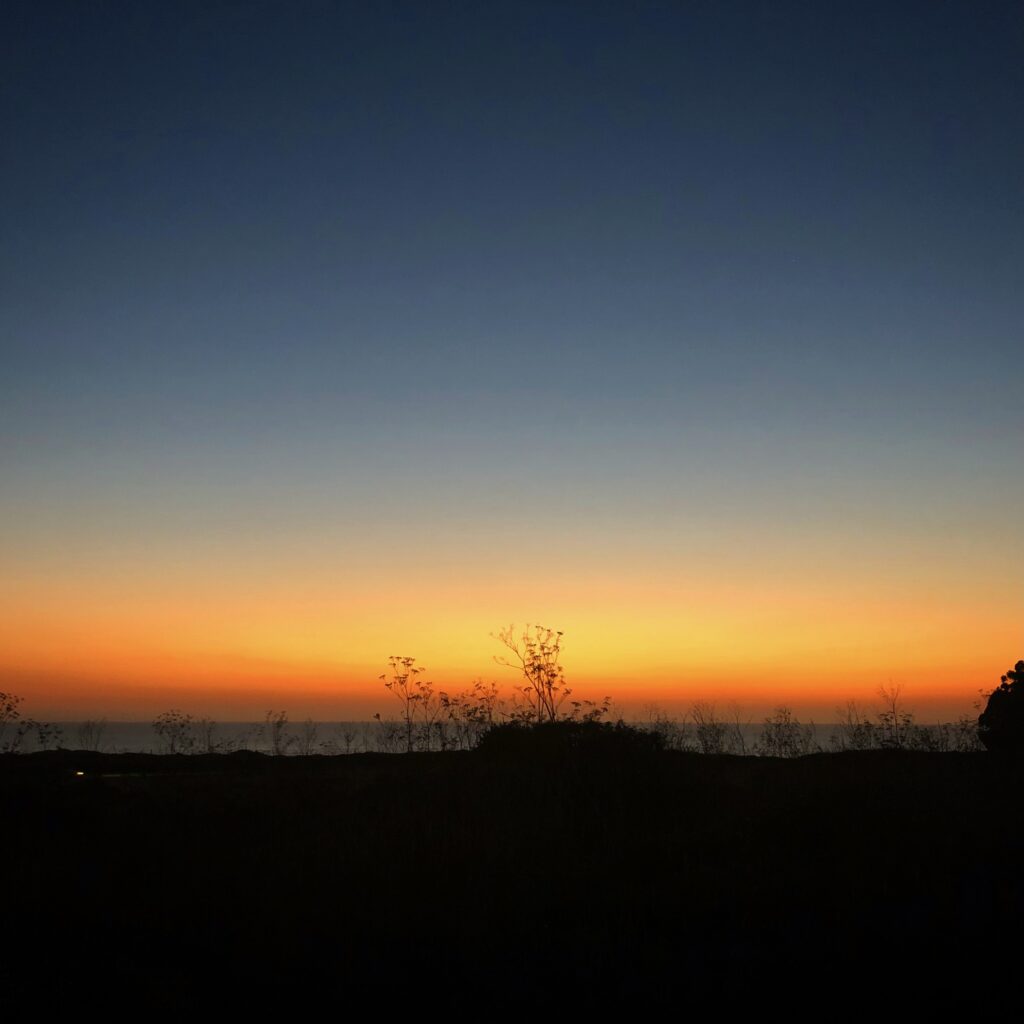
Wandering Sunward
By Santana Shorty
Originally published in Resilience, Issue #46 – Colors of Home
“I cannot decide if you are lightning or thunder.”
– Laura Pauskus
It is 2019 and I am in Pescadero, California. I am staying in a glamping village immediately off Highway 1 where the pavement mimics the ocean line. The resort is called Costanoa, and serves as a driveable, curated, coastal getaway for tech bros and their girlfriends. This weekend I am one of those tech bros and have myself brought many boyfriends here over the years.
The glamping tents are reinforced wood platforms and all the rage. You can simply put thick canvas over a cube frame, slap a queen bed inside to fill the majority of the space, hook up basic electricity and charge a normal four-star room rate for the experience. Glamorous camping.
I will leave out the part where you have to stumble out of your tent at two in the morning and walk through Pacific Ocean fog to the shared bathroom outpost in a flimsy cotton robe that will be damp by the time you return from your nightly pee. And I will leave out the mortifying detail that the tents are rented by mostly young couples who will have loud sex with the lamps on, offering a free, gratuitous shadow puppet show for all to see.
But I’ve been here many times, and I accept the reality of my frigid nighttime pee and I am here alone so I don’t have to worry about shadowboxing. This time, I am here because I want to die.
***
On my way to Costanoa, after the Pescadero turnoff, I come upon a family stranded on the side of the road. It is a young woman, a middle-aged man, and a child, perhaps six or seven. They are standing on an unforgiving highway curve, holding a red gas can up, brilliant beacon in the air.
I have been in San Francisco for nearly nine years and I’ve become almost proud of my developed street-smarts veneer: keep one ear bud out while walking on the sidewalk to stay aware, move to the other side if there’s a man, run only where there are street lamps, don’t give money to the homeless, don’t carry cash, don’t befriend strangers, look down most of the time.
 But in the singular second it takes me to pass the family at 60 mph, I remember driving with my dad on rural, reservation washboard roads, or the barren, gray highway between Cuba and Farmington, New Mexico, that crosses the Continental Divide, and the always offered ride in the back of the truck. Or the local drunk, who pulled up to our house on a wayward Tuesday to sell my mother green firewood she didn’t need and the $20 bill she handed him for it. The wood was unusable that season, and would have to sit on the porch for another year or two.
I would be breaking every rule a single, city-living woman should abide by, but I am homesick and generally hate my life so I flip a U-turn and come back to the family, pulling up behind their maroon 90s Chevy van, and get out of my car. The man approaches me, while the woman holds the child’s hand.
“Any chance you can buy us some gas? There’s a station in Pescadero.”
“Sure.”
“They’ll go with you,” he says, motioning to the woman and child.
I shove my road trip trash and overnight bag to the back, and the young woman alights to the passenger seat with her little one on her lap. I call her young woman, yet I think we are the same age. I wonder at the child sitting on her lap instead of the backseat, but we are not going far and I am not a mother.
“Where are you headed?” I ask.
“Fort Bragg. My husband’s gonna get work there,” she says.
We don’t say much more. When I pull up to the empty gas station, night has fallen. The pooling overhead lights look harsh on the cement and have a cutting periphery. I fill up their gas can as much as it will hold. $17.22. That will probably get them a little past San Francisco.
The full can seems to loosen the woman’s nerves and she starts chatting. She tells me about her love for her son: “I’ve taught him to count to 65 and he’s only three!” Her love for her husband: “He saw me when I was going down the wrong path and saved me.” Her love for nature: “I don’t use paths, oh no, I go right into the trees and bushes.” She tells me I will find someone who will fit me like a glove. She tells me to wait to have children until I am really sure. “I’m 23, soon to be 24,” she says.
When we return, the man thanks me and the woman lets fly a toothy smile. Their son starts to cry, and she rubs his head and cheeks.
“He hates goodbyes,” she says.
I get back into my car and wave as they refill the van, breathing life back into its rusty bone structure.
***
When I arrive at Costanoa, it is dark. I get my keys and pause too long at the concession, surveying chocolate-covered almonds, fancy rosemary crackers, and the wine selection – all overpriced and specifically for the people who come here and say, ‘well, we are on vacation.’ I unpack in my glamping tent. I am grateful there is no cell phone service, and for extra measure, I turn my phone off completely. There is a digital clock on the nightstand that will serve me just fine. The tent feels cold and damp, like wading through thin water, and I am eager to leave the space. Outside, I can’t see any of the classic California hills and shrubbery; everything is dark. Everything is dark.
At the on-site restaurant, the menu matches the energy of the concession stand. Seated next to the fake fire and ornate, stone mantle, I order the scallops and a bottle of Cabernet for just me. I am getting drunk tonight.
***
I am here by myself for two reasons: I am running away and trying to find something. Nine years ago, I arrived in the Bay Area for college. Against all odds, I got into Stanford University and as my mom left me after moving me into my dorm freshman year, she said, “I’m so proud of you for getting into this fancy school.” I learned many things – who Plato was, the impact of Dadaism on the trajectory of art, how to do calculus when I was bad at math, how to act like everything was fine when I was stressed beyond imagination, how to speak tech and keep up with the latest startup news, how to act visibly unimpressed by impressive things.
After fancy school, I couldn’t get a job. My human biology major felt useless and prepared me poorly for navigating the world. I didn’t have connections. I didn’t understand retirement plans or benefits packages, and I lived in a college friend’s family’s basement, who had built their wealth working at Goldman-Sachs. In the daytime, I worked at the charter school they started in the East Bay, and in the evening, they gave me lessons on networking and writing a resume for someone with no experience.
They helped me land my first job at a startup tech company, which gave me everything I needed to begin my life as an adult. I committed myself and progressed – I moved quickly upward, starting a new, advanced role every year with increased responsibility and giving more and more of myself with it. I ended a long-term relationship, moved deeper into San Francisco, and immersed myself fully in the Bay Area chase. I began drinking more, going out multiple nights in the week, buying experiences and trinkets to make myself feel better, all the while making just enough money to live, but never enough to save more than a month or so of emergency funds. Eventually, a depression so murky and deep took hold of me that I stopped noticing the sun.
***
Earlier today, I had my first-ever panic attack. I pulled into the parking lot at work and began crying even before I got out of the car. I calmed myself enough to get inside, but as soon as I opened my first unread email, the shaking became so severe that I fled to the bathroom. I was losing it and I had never lost it and I didn’t know what you were supposed to do when you lost it. My boss – a smart woman who had lasted the longest at this crazy-ass company – sent me home and ordered me to take the next two days off. She’d seen this before.
I fled to my car, tears and snot clogging my face, and drove west. The car guided me on and off Highway 280, into the narrow, hilly roads toward the ocean. Everything followed me. The never-ending to-do list of my job, the constant need to work harder than the day before, the rent for my room in a two-bedroom apartment that had mold, the text messages from a married man who I thought I loved, the home I would never own because I was living in a city where the starting price was $1.2 million. I was too exhausted to keep working, and I was too exhausted to find a new job, and I was too scared to make any sort of change that would free me. I was the furthest from myself and I didn’t know how to get closer.
***
I am here because I am trying to find something.
***
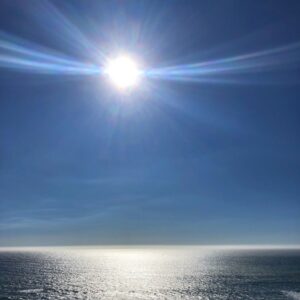 The pavement gave way to the ocean horizon, white light skating along the windowpane of the world. I parked and ran to the water’s edge and cried until I wrung myself dry. Sitting on the fringe of the Pacific Ocean, I wondered what to do next. More crying wanted to come out, but I was too dehydrated – a desert being without water staring at the largest, undrinkable expanse of it. I thought of home. Though I had been in the Bay Area for almost a decade, when I said ‘home,’ I always meant New Mexico. When I thought of ‘home,’ I thought of rustling cottonwood leaves, the windchimes of fall. I thought of the irrigation waterfall outside the adobe house I grew up in, and how we would leave the windows open on summer nights, the hushing sound of cascading water pulling forth the calm of night. Perhaps that is why I ended up here, seeking comfort from a water body that I couldn’t give to myself. The fancy school smarts were not going to help; trying to use logic to get me out of my mess had become an unending circular loop.
From my bag, I dug out a piece of paper and wrote the following promise,
What a life it must be,
To live one that you choose.
How might you live given that chance?
I will tell you a secret.
You have that chance.
It should feel both magical and mundane.
Both epic and empty.
Both transformational and tame.
The most natural act is to find yourself.
The most rebellious act is to be what you find.
Be grateful without shame.
Be humble without guilt.
Be honest without omission.
It is natural for you to doubt.
It is normal to feel like your world’s most critical moment is taking place right now.
The tectonic plates of your soul are shifting.
Earthquakes are simply growing pains.
It always comes back to Earth, Mother.
People pay money to get closer to her.
To spend days in silence with her in the mountains, hoping, praying, waiting to hear her voice.
How lucky you are to find her whenever you need.
At the ocean’s end, at the river’s sleeve, at the night’s edge.
Today you start your ceremony.
Tonight you start your healing.
And tomorrow you begin anew.
Rise with the sun and give thanks,
For a good night’s sleep,
But more importantly,
For waking up.
I folded the paper into my notebook and looked back out to the water. Pulling out my phone, I decided I needed to spend a couple nights away. I couldn’t think in the apartment with my roommates hovering. I didn’t want to be anywhere in the city or with friends. I wanted to stay right here at the water, or as close as I could get. Costanoa was perfect and I booked a glamping tent for that night and the following.
I drove to San Francisco to pack my bags. I decided I would approach this mental breakdown and need for reprieve with the same gusto as I did anything I needed to accomplish: I made a plan with appropriate supplies. I needed a new journal. I needed smooth-writing pens. I needed sweatpants, a swimsuit, and the cozy PJs that no one was allowed to see me in. I needed to have all the necessary materials at the ready for inspiration to take hold, for planning and prosperity to grace me with an epiphany and bonus kiss on the forehead.
Before leaving the city, I stopped at a favorite stationary store. Mostly I window-shopped – the array of glossy and matte journals of varying sizes, all with the eclectic paper varieties to make a stationary glutton’s heart sing. I thumbed through journals, feeling for my ideal paper grain, pushing aside wide-ruled and dotted sets. Once I found a suitable candidate, I moved on to the pens. Testing their ink release and line stroke was the most joy I’d felt in weeks, and I wrote little nonsense messages on the sample journal that had been left out for testing pens. I turned to a page with more white space to try the pen in hand, but then froze, staring at the page, cluttered with heavy blue lines, spindly red ink patterns, bright baby blue marker, and more. I picked up the sample booklet, my palms aching under the weight of sweat and my breath shallow in my nose. On the left page was my name. Santana. Written, not by me, in slanting, blue ink. On the right page, in large, blocky green letters, were the words, “Learn to Listen!” Placing the booklet down, afraid it would say more that I wasn’t ready to hear, I glanced around the room, searching for the face of anyone familiar, anyone who would know my name – an altogether highly uncommon one, especially here. I quickly paid for my journal and pen, rushed to my car, and aimed southward.
***
I am here because I am running away.
***
The wine is making me rethink the day. The week. The year. This is all just the late twenties slump I’ve heard so much about. Saturn Return is a convenient term made up by people who needed the prefrontal cortex development of their late twenties to finally dump their college boyfriend. Blowing up my life is not a solution, nor is it prudent. Leaving this career and city would be going against everything I worked for, everything my family sacrificed for me. Valedictorians from small towns who manage to graduate from a top college with a full-ride scholarship don’t go back. Going home is failing and I don’t fail.
Eventually, I pay too much for my dinner and find myself in the hot tub. Alone. Drunk on Cabernet. A dumb combo for a smart person. The emboldened light from my poetry promise earlier on the shores of the ocean starts to feel feeble and ridiculous in comparison to the hollowed-out core of my gut; the unabashed banality of being a sad, drunk girl alone at a nice resort trying to find herself. I do not know what to do and I am regretting the wine.
The stars have decided to join me. They shudder behind layers of worn clouds and lackluster ocean fog. Twilight is bold in her rendering, and her royal blue provides enough contrast to bring the surrounding shadow of sloping hills into focus. I pull myself out of the hot water and lay on the particle board that makes up the deck. The fake wood grain, a far cry from the Mother Earth that my body knows intimately, suspends me, offers me up to the sky and I let it. I consider my skin. I consider the heat in me. How water can be boiling on either side of the membrane, and I only need to shift my body, to move it elsewhere, to make it stop. How it is in my control to change the environment and conditions for my body to exist. To survive. To flourish, even.
How much of wanting to go home is simply nostalgia? Does home only exist in our memories? How much of it is yearning for the familiar? For the open-armed blue that is the summer desert sky? For the wild spring blizzard that takes you by surprise – to no one’s surprise – every year? For the purple aster and dusty juniper and regal ponderosa pine? Does wanting to go home make one less adventurous? Less worldly? If we are children of the Earth, shouldn’t anywhere feel like home? Shouldn’t everywhere feel like home?
The sky is spinning and I cling to the floorboards. I am racing through the galaxy with hot tub in tow. Every option I consider that would keep me here, in this job, in this life, in this city, feels like it will eventually kill me. I am not being dramatic. Nor am I textbook suicidal, but I feel a heaviness in continuing this existence that can best be described as being so very, very tired that all I might want is to go to sleep and not wake up. Every option I consider that would take me away from here is living. And when I think of living, I see my mother laughing, in that way that crinkles her nose and eyes; the laugh that sends her bending forward, as if praying to the Earth. I see my family home, framed against the wheeling cerulean sky and mesas brimming with sharp and fragrant juniper berries. I see my dad, driving ribboning roads through varying New Mexico landscape that is both simultaneously and distinctly desert and mountain and river valley, eagle feather hanging from the rearview mirror, ebbing against the cut of air from the open window. I feel the southwest sun, burrowing into my skin, but I am not burning. I am light.
I will not remember getting back to my glamping tent. I will not remember changing into my unsightly PJs and going to sleep. I will not remember what I cried about, though I can guess.
But I do remember waking up.