

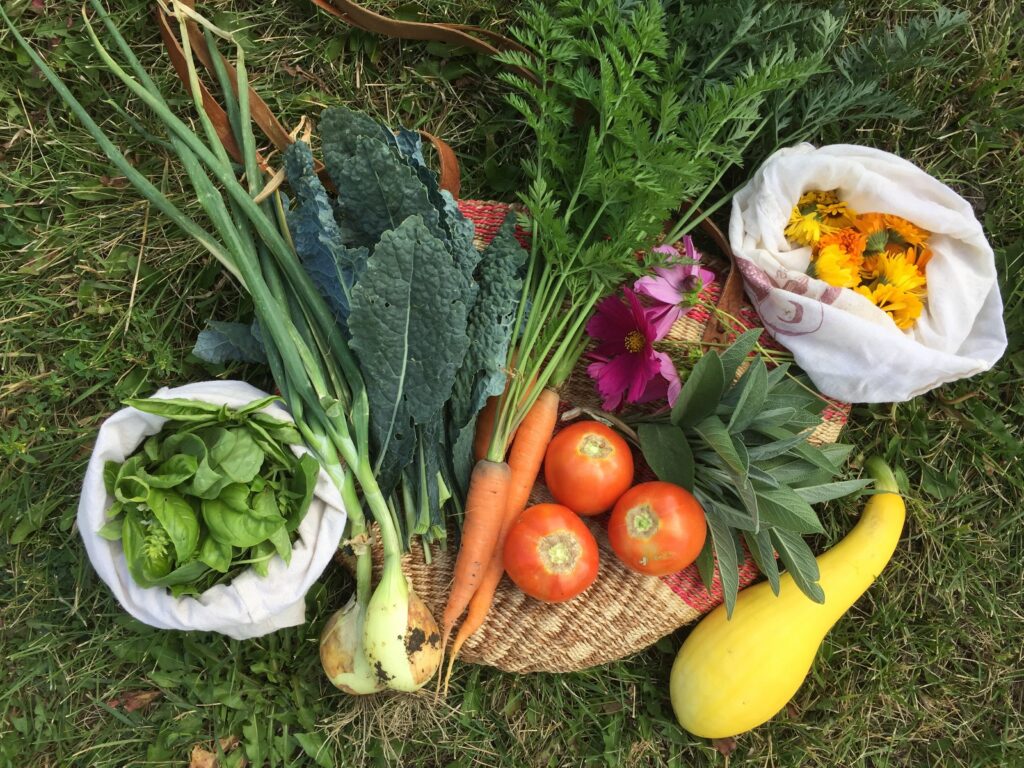
The Colorful Truth: How Plant Health Affects Pest Resistance and Nutrient-Density
By Mattie Griswold
Originally published in Resilience, Issue #46 – Colors of Home

Have you ever walked into a grocery store, farmers market, farm, or your own backyard garden and been struck by the vibrant colors of fruits and vegetables? Perhaps it was the pyramids of shiny apples, dewy green leaves, or bright red strawberries drooping from their branches. I don’t know about you, but when I see all those deep, rich colors, I usually get a little hungry.
You’ve probably also noticed when produce appears sad or dull. I grew up in a rural community with two small gas station grocery stores where that was a regular experience. In winter, road closures would often delay the already infrequent deliveries of fresh produce to our town. I remember seeing the same tomato on the shelf week after week, more dull pink than red, certainly not enticing anyone to take it home. In our current global food system, much of our produce is harvested before it reaches full ripeness. While early harvesting increases shelf stability for global shipping, it also explains why those tomatoes look and taste so bland.
There’s science behind our intuitive attraction to vibrant produce. I recently learned that a plant’s color – whether in its leaves, blossoms, or fruit – indicates not only the plant’s health but also its nutrient density. Generally, fruits and vegetables that appear vibrant in color are higher in phytochemicals, bioactive compounds that are critical for human health and help protect against chronic disease. There are exceptions, of course. Humans have invested heavily in plant breeding and genetic modification to produce greater yields, often at the expense of nutrient density and flavor. It makes sense then that those fruits and vegetables found at local markets, farms, and gardens that are in season and traveled shorter distances were more likely ripened to their full phytochemical richness on the vine, making them both healthier and tastier for us.
The Surprising Role of Pests as Indicators
While the connection between color and nutrition may seem intuitive, until recently, I didn’t understand the direct correlation between plant health, nutrient density, and insect pests. In early 2025, I attended a talk by Dr. Tom Dykstra, an entomologist who helped me understand that insect “pests” actually play a vital ecological role – they consume unhealthy plants.
Just as turkey vultures with their powerful stomach acid serve critical ecosystem functions by consuming carrion that other animals cannot digest, insect pests fill a similar role by consuming unhealthy plants. What we often overlook is that pests aren’t attracted to our healthy plants, but rather our unhealthy ones. According to Dykstra, insects only feed upon plants that are nutritionally poor, dying, or dead. Consider the thousands of species of dung beetles worldwide (450 specializing in cattle dung alone), termites feasting on decaying wood, or dermestid beetles that consume decaying flesh and clean skulls. Similarly, bark beetles don’t kill healthy trees – they kill unhealthy ones.
What Makes a Plant Healthy?
A plant’s health depends primarily on how well it photosynthesizes – aka its ability to transform energy from sunlight, water, and carbon dioxide into sugar and oxygen.
As someone gardening in a deep, narrow canyon between two steep forested hills, where direct sunlight is limited, my plants don’t always photosynthesize well. It’s not uncommon for my annual veggies to appear stunted, and I typically end up with a thriving population of insect pests by season’s end. Sometimes I question whether I should attempt gardening at all, given that my growing season is even shorter than in the nearby Gallatin Valley where on average, growers can expect a 100-day season. The short and often unpredictable growing season we face at 45 degrees North makes growing annual plants a challenge.
Throughout my 34 years of life, I’ve grown many gardens, attended permaculture and master gardener courses, and managed community gardens; despite all of this, my approach has evolved to be more intuitive than scientific. Aside from adding some compost to the soil each spring and mulching my beds with straw and leaves each fall, I have put minimal effort into understanding the root cause of my garden challenges, much less changing my practices. While this has served me well in certain settings, I was excited to discover a simple tool for quickly assessing plant health: the refractometer.
Measuring Plant Health With a Refractometer
Refractometers are small instruments that provide insight into how well plants are photosynthesizing, helping growers prevent pests, increase nutrient density of crops, and troubleshoot when things go awry. These tools are readily available online, and can range in cost from $20 to $300. Built like small telescopes with a viewfinder and a plate where plant sap can be applied, refractometers are commonly used in the wine, honey, and juice industries to determine optimal harvest time by measuring sugar levels in fruit. For gardeners, farmers, and ranchers, however, they can be used to measure leaf Brix.
Leaf Brix refers to the sugar content in plant sap and correlates with the presence of phytochemicals and thus, health and nutrient density of a plant. Since Brix levels depend on photosynthesis, several factors can influence readings: time of day, atmospheric pressure, soil health, cloud cover, and soil moisture. Plants grown in greenhouses tend to be UV-deficient and will have lower Brix than those growing outside. Leaf Brix is typically lower in the morning compared to the afternoon, when sunlight intensity increases. The application of herbicides, fungicides, and insecticides, can reduce Brix by destroying beneficial soil microbes, crucial for soil health. Given these variables, some skeptics question Brix as a reliable measurement, but when used consistently, and in conjunction with careful observation, it provides valuable insights into plant and soil health.
The Brix-Pest Connection
Generally, plants with low Brix (6 or below), aren’t photosynthesizing optimally. Not coincidentally, insect pests favor plants with low Brix. Aphids, for example, are attracted to plants with Brix readings of 6-8, while grasshoppers will consume plants with Brix levels of 10-12. Plants are generally safe from insect pests when they reach Brix levels of 12 or higher, eliminating the need for pesticides and indicating that the food you’re growing is healthy for humans, not insects. At a Brix level of 14 or higher, insect pests won’t even glance at your crops.
In their respective books, “Dirt to Soil” and “For the Love of Soil,” both Gabe Brown and Nicole Masters emphasize the importance of increasing Brix levels as an indicator of soil health improvement over time. This simple measurement can transform how we understand the relationship between soil health, plant vitality, pest resistance, and ultimately, the nutritional quality of our food.
Bringing It All Together
Being able to see the connection between plant health, nutrient density, and pest resistance gives us powerful tools for growing better food. By focusing on improving soil health and optimizing growing conditions to increase Brix levels, we can naturally deter pests while producing more nutritious crops. Whether you’re managing a small backyard garden or a larger agricultural operation, monitoring Brix levels can provide valuable insight about your growing practices and inform decisions.
Next time you’re admiring colorful produce at a market or in your garden, remember that those vibrant hues aren’t just pleasing to the eye – they’re nature’s way of signaling optimal health and nutrition. And if pests are attacking your plants, consider it nature’s feedback system telling you there’s room for improvement in your soil or growing conditions. With this knowledge and simple tools like a refractometer, we can work with nature rather than against it, producing food that truly nourishes both our bodies and our soil.