


The Color of Piñon Country
Words and photos by Christina Selby
Originally published in Resilience, Issue #46 – Colors of Home
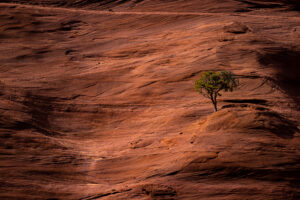
On rugged mountainsides and red rock mesas throughout the intermountain West, piñon and juniper trees grow where few others can survive. Humble by almost any standard, their gnarly, stumpy stature has rarely inspired poetry or exhalation like the heights of sequoias or baobabs present in other parts of the world. And yet, those of us who live in this rugged “Piñon Country” know that piñons, and their companions, the hardy juniper, are the lifeblood of these arid states.
As a photographer, I, for many years, had ignored this landscape right out my back door. Color is what often attracts me to want to photograph a landscape. I can’t resist a mountain meadow teeming with a rainbow of flowers, buzzing with pollinators, and filled with birdsong. I had not known the piñon-juniper ecosystem to be as eye-catching as my beloved mountain meadows. A sea of army green junipers and blue-green piñons seemed the only constant against the big, blue New Mexico sky. Then, in 2022, I began a multi-year conservation photography project to visually document the lives of pinyon jays and their unique relationship with piñon trees. I traveled across the Southwest, returned in different seasons, sat under trees for hours, and listened for the call of pinyon jays. As my experience and understanding of this landscape deepened, one thing became clear – the presence of color in this ecosystem is a clear sign of health.
Pinyon jays are a social bird with a deep relationship with the piñon tree. They depend on piñon for food, shelter, and nesting sites, and in turn, they are the main dispersers of piñon seeds. Large flocks of pinyon jays can gather millions of seeds in a few weeks and store them for winter at cache sites. They remember where they hide 90 percent of their seeds, but the 10 percent they forget enable these woodlands to rejuvenate and establish in new areas.
Unfortunately, mass die-offs of piñon pines from insect infestations brought on by long-term drought, clearing of land for housing and energy development, and thinning for fire suppression and livestock forage have contributed to the loss of 85 percent of the pinyon jay population across the West. In 2022, the pinyon jay was petitioned for listing on the Endangered Species Act. In 2023, the U.S. Fish and Wildlife Service acknowledged there was sufficient information to warrant further review but a final decision has been delayed and their status remains in limbo. The impetus for my photography project was to support the petition by creating media that would educate a broad audience about the lives of pinyon jays, the importance of their habitat, and the challenges they face.
I began my project where I live, in Santa Fe, where piñons and junipers are the dominant trees across the landscape. The trees give texture to the land from the foothills of the stunning Sangre de Cristo Mountains, with their dense old-growth piñon woodlands, to the Caja del Rio Plateau, where the Rio Grande cuts through rugged juniper-dotted grasslands.
Pinyon jays use this entire landscape, and in Santa Fe we can still find some of the most abundant populations of these birds. Historically, they formed mega flocks of over 500 birds in the fall and winter as they scoured the land for their preferred food – piñon seeds. However, today in most places, groups of only 20-30 birds are more common.
Pinyon jays are year-round residents, but because their home ranges can cover an area of 10,000 acres or more, they are not easy to find. To document this story, I partnered with scientists and traveled across four states, meeting them as they conducted studies on pinyon jays in the field. When they can find it, pinyon jays favor old-growth piñon woodlands where mature trees provide better cover for their nests and fledgling young in the spring, and more abundant seeds in the fall. In these centuries-old woodlands, I found that color abounds.
As I searched for social flocks of these birds, I spent time with them throughout the day to understand their behavior. I noticed how their feathers change color in different light. In the full strength of the midday sun, their feathers became a brilliant cerulean blue, as blue as any tropical ocean bay. Birds, unlike many other animals, don’t possess a pigment that produces blue color; the color is a result of how light interacts with the microscopic structure of the feather. Blue wavelengths are scattered and reflected when light hits the feather, while other colors are absorbed. Like the woodlands they live in, mature birds are more colorful than young grayer birds. They come into their full blue-ness over time.

As I followed these blue feathered flocks, I traveled to relatively undisturbed woodlands where, unlike in the juniper grassland of my backyard trampled by dogs, people, and occasional goat herds we hire to cut the grass, the ground was often protected by mounds of cryptobiotic soil, or “biocrust” for short. This craggy, often dark or burnt-looking carpet stretches between shrubs and grasses in arid lands. At closer inspection, biocrust mounds often contain verdant green moss and algae, lichen in shades of lime, brown, grey, and blue-green cyanobacteria. This – the earth’s skin – is a community of living organisms that hold together the soil surface of drylands. They take time to mature and form. The most colorful of them can be several decades or centuries old. It keeps soil in place, holds in moisture, and regulates soil temperatures, all factors which piñon trees need to survive and produce seeds.
***
In winter, I would travel to Piñon Country around Taos and Questa, New Mexico. White snow blanketed the piñon woodlands under grey winter skies, accentuating the human size of the individual trees and the vast areas these woodlands cover in the West. Piñon woodlands form bands around mountain ranges throughout the Southwest, marking the transition zone from desert lowlands to the high alpine environs. During my visits, I would find some of the largest flocks of pinyon jays I’d ever seen. In late afternoon, they would roost in groups on piñon tree branches sagging with their collective weight. I watched through my lens as pinyon jays preened and murmured to each other, settling in for the night.
In late winter, or mud season, in the rural outskirts of Montrose, Colorado, I found color in sunburst lichen forming bright yellow sun stars on black volcanic rocks that share space with orange firedot lichen. Another slow grower, lichen is that most alien of plants, a symbiosis of algae and fungi. Usually less abundant around urban areas, their presence is an indicator of air quality. I watched from a distance as a large pinyon jay flock noisily chased off a pair of ravens attempting to invade their nesting grounds.
When spring finally arrived outside of Flagstaff, Arizona, wildflowers signaled a healthy ecosystem. The full “Pink Moon” of April shone down on the flower that gives it its name. Pink phlox formed great mats in the juniper-studded hills blooming in spring after ample winter precipitation. At another spot, the orange and black gravel in the mouth of volcanic cones were dotted with coral-colored Utah penstemon. Here I found a small flock of pinyon jays opening still green pine cones with their long needle-like and feather-less beaks to feed their fledgling young.
In the foothills of Salida, Colorado, broken branches on piñon trees dripped with sap that hardened to a golden yellow and crystalized into geometric shapes refracting the light of the setting sun. Pinyon jays flew overhead, chasing each other in the aerial acrobats that are part of their mating rituals. In a healthy woodland, the ips bark beetles help dead trees decompose and serve as bird food. When the insects tunnel too deep into the wood, trees produce sap to push the beetles out – a self-defense mechanism no longer possible as higher temperatures and long-term drought create even drier soils and trees lack the moisture needed to produce their sticky sap traps.
***
Four years into this project, I’ve come to understand firsthand how color is the triumph of a diverse, healthy, and vibrant piñon-juniper ecosystem. Resilience is all shades of the rainbow in Piñon Country, and it takes time to grow. This project has shown me that I, like many of us, am prone to what scientists now call “shifting baseline syndrome,” a tongue-tying phrase to describe the gradual change in our perception of what constitutes a healthy ecosystem. Each new generation accepts a more degraded environment as “normal,” due to a lack of understanding of the historical state of the environment.
The absence of color in some areas of these iconic woodlands of the Southwest highlights the challenge ahead of us to care for and keep this ecosystem thriving. However, where color persists in the sunburst-covered rocks, spring blooms, golden fractals of sap, and the deep green hue of a fresh pine cone that dries and opens to a crisp brown teaming with the piñon seeds that nourish life in Piñon Country, so too persists the abundance of life in these woodlands.