


Talking Transition
Emily and Kyler Brown, Interview by Anica Wong
Originally published in Resilience, Issue #45 – Searching for Home Ground
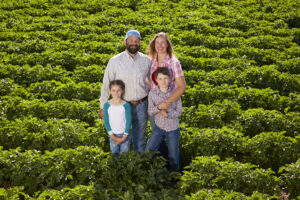
Emily Brown certainly didn’t see herself coming back to her family potato and barley farm in the San Luis Valley of Colorado, but a husband, two kids, and global pandemic later, she finds herself learning how to farm from her parents and becoming an active participant, along with her husband, Kyler Brown, in succession conversations with her family. In this interview you’ll hear from both Emily and Kyler about what legacy, land, and birthplaces mean when the family is tied up with the business.
Emily: We live and work on my family’s farm in the southern part of the San Luis Valley, north of Monte Vista. My dad’s mother’s family moved to the area when there were some different promotions to get people to settle in the Valley. They settled and started farming potatoes. My grandma’s aunts and uncles had different parcels of land in the area, too.
My grandmother met my grandfather, and he was the one who then consolidated the farm into what it looks like today; he leased and rented out a few different pieces of land, but then bought out some of my grandma’s aunts or uncles. My dad grew up on the farm but he didn’t really plan to come back to the farm or didn’t really think that he was going to be a farmer; he went to school to be a teacher because he had a lot of teachers in his family. But then mostly he was a ski bum.
***
I have a master’s in public health and was working as a contractor for the state public health department out in Nevada. I didn’t have leave benefits as a contractor and we had gotten pregnant and I was ready to have our first kid. My mom had come across this job description for a public health director at the county where I’d grown up. I looked at it, considered it, interviewed for it, and they offered me the job. I told them, well, I can’t really move out right away because I’m about to have a baby, but I can be out in a few months. And so we moved from Reno back to Colorado when our son was a month old.
At that time, my dad was sort of not sure what to do on the farm so Kyler came on to help on the farm. And then about three years ago, I came on more full time to do the farm’s bookkeeping.
and part of that was just the interesting timing of that; I had gotten fired from the county during COVID as a public health director.
Kyler: When we came back 10 years ago, Emily had a job lined out and I said I would help get her dad through planting and, I guess, I have just stuck around. They have a section of land that straddles the Rio Grande River that had been leased to a neighbor for almost 30 years who had run some cows on it. It’s a peaceful place that her dad and grandfather liked to have as a little refuge away from the farm; the farm can be pretty windy, pretty sterile, but you come over to the river and there’s a lot of cottonwoods, a lot of wildlife.
When I came on, we started the transition to where I took over that lease and Emily and I, eight years ago, bought our own cows and we’ve been slowly growing that operation. So far, it’s our own operation separate from the farm, but without the farm, it probably wouldn’t work very well. We keep doubling our herd every few years, and we’ve increased and gotten some leases so now we run on not only this property, but several others, including one in New Mexico.
In the last four to five years, we’ve finally had some much stronger conversations about what succession looks like.
Emily: It’s not like this stuff is written down in a manual and you can just hand it over to someone. It felt like my dad wanted to see how it felt before he said that we’re going to be part of the farm or having real serious transition discussions.
My dad and his sisters had a pretty tough transition. My grandpa and grandma had done a lot of work to try to figure out how to transition the farm to my dad without having him be in a situation where he could possibly lose the farm or have to pay all of the inheritance taxes. There was a lot of tension and frustration around what payments for the partnership looked like or how the land transition worked. We just don’t have the same relationship with my aunts because of some of that process. It was a really hard thing: the different sides feeling like the other sides didn’t recognize where they were coming from, all the nostalgia and feelings caught up in ‘family’ and ‘parents’ and what people wished for.
Our family is still closely connected to that transition. And so it was like, oh man, we’re getting ready to do this again. And we don’t want it to go the way that it did then. In some ways, I think we are doing so much better. In some ways, I think we are in the same boat. My mom has been a big voice for trying to have better conversations and moving this along in a different way.
There’s a guy who does transition planning with the extension services and we had taken one of his classes about transition and it made us start thinking about all of this. And then we had a few family meetings where we talked about what people feel about the land and what their thoughts are. Through Rocky Mountain Farmers Union we had made a connection with someone and my parents had him come down and we did a two-day session, which was pretty intense. He facilitated a process with my siblings where we had to dig a little deeper into what everyone’s thoughts were about next steps for the farm.
Kyler and I are now partners in the LLC with my parents. We’re on a track of trying to figure out what that looks like to buy in or take over more of the shares of that or a larger percentage of the LLC. This includes the storage and the warehouse and the equipment and the farm income. My parents are working on more discussions around the land, but that’s definitely a piece that’s still, as far as I understand it, it’s still set up where it’s my sisters and me, and it’s split three ways when my parents both pass away.
And so that’s a little scary to think about as you’re making improvements to the land. The Valley’s having a lot of concerns about water and how the water is tied to land, and so as we try to think about how we’re taking next steps on the farm business and making improvements to the farm or making decisions around what we’re farming or ranching, how is that changing what might be the future depending on what happens with the land down the road.
***
Kyler: Being the in-law is kind of a fascinating thing unto itself, as is being a male with the three daughters. There are some generational gaps and I wouldn’t say that my father-in-law is the best communicator, so that’s created all kinds of interesting situations, no matter whether it’s family or not. But family just makes things all that more tricky where, if you have a rough day at work, and then you’re supposed to go have a barbecue with them in the evening, these are still people you call family.
Emily’s folks did what they knew and did what they saw their parents do, and had fears of people losing the farm that they saw all around them. And so I think they wanted to make sure that Emily and I were highly invested. And, probably more than anything, invested with our time and our sweat equity and that we had set down roots here. They didn’t want to start a transition process when they thought we might pick up and leave. We also have two kids and so that’s been a fascinating development with us choosing to live here and them being able to have that relationship so close with their grandchildren. I think that’s pretty special to them and that kind of furthers this succession question.
What is inheritance? And what does that mean? And then there’s the other side of that of having a family home and having a birth place. Her two sisters don’t live here, but it’s still their birth place and their parents still live in the same home they were raised in. And so when they come back for Christmas, there’s an assumption that this birthplace will never change. So that in itself has a whole series of factors that lead into ‘what does succession look like?’
There’s the business side of it where there’s real dollars and cents. The land has real value. The water has real value. The crops have real value. And you can get down into the weeds really quickly about how to economically actually transition a farm. I think Emily and I’ve put a lot of effort and thought and time into the farm and the management of the farm, and I think her parents feel much safer, much more comfortable with us taking over more and more of the management decisions, more of the finances. It’s been us investing and proving that we can do these things and them slowly releasing their grip and not having to stress so much and let someone else stress out about all those decisions.
But we haven’t quite gotten to those big financial questions of how we really transition this farm. And that’s where you have the conversations about what is equitable, what is equal, what is fair, what is equity.
Emily: Both of us like living in the rural community and working in agriculture. I think there’s a lot of unique elements of the San Luis Valley: there’s some balance of political views and some racial and social diversity that all rural areas don’t have. We have some good friends and community and have that kind of connection where if something happened that we needed help, we have a good support circle that we could call on.
At least for me, continuing to try to figure out how to make a living on the farm is a lifestyle that I want and a community that I want. I also think there is something tied to being a producer, being someone that produces meat or beef or potatoes. And even if I don’t necessarily subscribe to the idea that farmers feed the world per se, the fact that you can put something in the ground and take it out and eat it and other people eat it, too… that is a pretty valuable lifestyle and profession.
Kyler: It’s interesting that we call it succession or transition because pretty much all the levers of control are held by the elder generation. Emily’s dad has been the primary owner/operator of this farm for 20 years but he feels like he just transitioned to take it over from his dad and now he’s having to do it again. Farmers are kind of natural-born warriors because there’s just so many variables out of your control. And so, how do you control the transition of a farm when you can’t even control how planting a crop is going to go?