

Sustaining New Mexico’s Ponderosa Pine Ecosystems: A Collaborative Approach Across the Reforestation Pipeline
Aalap Dixit and Joshua Sloan
Originally published in Resilience, Issue #45 – Searching for Home Ground
Introduction
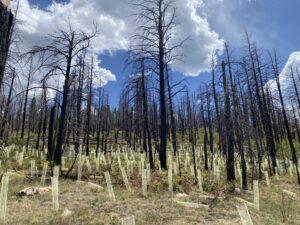
Climate change threatens the sustainability and productivity of forests across New Mexico and the American Southwest. In New Mexico, ponderosa pine forests have great economic, ecological, recreational, and cultural value. However, climate change has increased the intensity, frequency, and severity of abiotic and biotic stressors such as wildfires, droughts, heatwaves, and pests, resulting in a loss of ponderosa pine forest cover along with declines in natural regeneration. Artificial regeneration by planting high-quality nursery-grown ponderosa pine seedlings can be used to overcome these losses and help maintain forest cover in this region. However, early survival of planted seedlings is often low and needs improvement, and not enough seeds are currently available from appropriate seed sources to meet New Mexico’s reforestation needs. To help address these and related reforestation challenges, the Target Plant Concept was developed as a practical framework for planning effective reforestation operations. According to the Target Plant Concept, effective reforestation operations must: 1) clearly identify one’s reforestation objectives, 2) identify the characteristics and limitations of the site needing reforestation, 3) identify ways to overcome those site limitations, 4) identify the species, genetics, and stocktypes most appropriate for the site and objectives, 5) identify the optimal planting tools and techniques for the site and stocktype, and 6) identify the optimal planting season for the site being reforested. Additionally, achieving reforestation success through the Target Plant Concept requires communication and collaboration among partners, including landowners, foresters, seed collectors, nursery managers, planting crews, and other stakeholders in order to ensure effective coordination and to create a positive adaptive management feedback loop where all partners can learn from each other and from their collective experience working on reforestation projects. This planning process needs to be integrated throughout the reforestation pipeline to improve the survival of planted seedlings relative to historical efforts. Notably, in New Mexico alone, current estimates suggest that about 1 to 2.6 million acres of moderately- to severely-burned forests need to be replanted, requiring nursery production and planting of about 150 to 390 million seedlings if a typical low historical planting density of 150 seedlings per acre is assumed. This, in turn, translates to as much as 60,000 pounds of tree seeds that must be collected. To meet these needs and overcome New Mexico’s reforestation challenges, an all-hands-on-deck approach is needed that builds and strengthens partnerships between local communities, nurseries, scientists, and agencies across all areas of the reforestation pipeline, including seed, nurseries, and planting operations. Many activities are already underway and much progress is already being made through the work of the recently created New Mexico Reforestation Center and its partners.
New Mexico’s Reforestation Pipeline
The New Mexico Reforestation Center (NMRC) was founded in January 2022 as a partnership between the New Mexico Energy, Minerals, and Natural Resources Department’s (EMNRD) Forestry Division, New Mexico Highlands University’s Department of Forestry (NMHU), New Mexico State University’s John T. Harrington Forestry Research Center (NMSU), and University of New Mexico’s Department of Biology (UNM). The mission of the NMRC is to meet the current and future reforestation needs of New Mexico and the greater Southwest through its comprehensive seed bank, nursery, and planting operations combined with research, education, and outreach activities. To accomplish this mission, the NMRC has adopted an integrated approach to reforestation that brings together a broad range of stakeholders, including landowners and community representatives, state and federal agencies, tribes, non-governmental organizations (NGOs), and universities to meet New Mexico’s reforestation challenges across the three major areas of the reforestation pipeline: 1) seed collection and storage, 2) nursery production, and 3) planting.
Seed Collection and Storage
The collection, processing, and storage of high-quality tree seeds is the first step in the reforestation pipeline. For ponderosa pine, local, climate-adapted seeds are needed to support large-scale reforestation operations in New Mexico to help mitigate losses of forest cover caused by wildfires and climate change. Successful reforestation requires the use of seed sources adapted to both current and future climates, as well as local conditions on a reforestation site, and this often requires the use of locally-collected seeds. This, in turn, requires information and research about the genetics and adaptability of potential seed sources, and the use of screening techniques (e.g., common gardens and provenance trials) combined with scouting efforts to identify mother trees and populations that may be more adaptable, stress-tolerant, and resilient under future climates. In the early stages of seed collection, workforce needs typically include scouting for cone crops and mother trees, and community partnerships are important for identifying potentially valuable and productive mother trees. Later in the seed collection process, these same partners often provide valuable assistance with monitoring cone crops, providing access to private lands for seed collection, and assisting with seed collection in roles such as tree climbers, ground crews, and technicians.
Seed collection is expensive, but these costs are usually hidden in the price that landowners pay for seedlings from the nursery, which leads to the true costs and value of seed collection often being overlooked. Many factors contribute to seed costs, including: personnel time and travel associated with scouting and monitoring of cone crops; tree climbers and ground crews collecting the cones from mother trees; transportation of cones to the extractory and/or seed bank for processing; cone processing and seed cleaning; seed testing; seed storage; equipment and supplies for seed-related work; vehicles and maintenance for field crew transportation; and many others. Currently, newly-collected ponderosa pine seed in New Mexico may cost around $0.05 per seed. This sounds cheap until we scale up this seed cost to reflect the amounts likely needed to overcome New Mexico’s reforestation backlog. If we assume a current reforestation seedling need of 150 to 390 million seedlings and an average sowing rate in the nursery of 1.5 seeds per seedling produced, this would add up to $11,250,000 – $29,250,000 just to cover the costs of seed collection, processing, and storage at the scale needed to address New Mexico’s reforestation needs to date.
At this stage, ongoing and planned projects encompass several initiatives. These include a ponderosa pine provenance trial in Mora, New Mexico, with over 75 seed sources of ponderosa pine and a common garden study in Flagstaff, Arizona, with 21 seed sources of ponderosa pine evaluating differences in survival, growth, and physiology under field conditions with direct implications for reforestation in New Mexico. Additionally, the NMRC’s seed extractory and seed bank, housed at NMHU, lead the state’s efforts to collect, process, and store the seeds necessary to meet New Mexico’s reforestation needs. In 2023, the NMRC trained over 25 seed collection tree climbers and collected approximately 3.8 million seeds that will be used to support reforestation efforts in New Mexico and Arizona. The amount of seed collected annually is expected to increase as we build additional capacity and expand the workforce. Additionally, the NMRC uses its seed collection operations as opportunities to partner with landowners, agencies, tribes, and NGOs to provide trainings in seed scouting, monitoring, and collection, which allows its operations to double as professional and workforce development activities. This will ultimately increase New Mexico’s reforestation capacity while helping people develop the knowledge and skills needed to meet their community’s reforestation needs and participate in the developing reforestation economy. However, even with a growing supply of locally-adapted seed for reforestation in New Mexico, seed will remain a limited and valuable resource for the foreseeable future. Therefore, it is important that we also invest in the nursery infrastructure and programs needed to increase the supply of high-quality reforestation seedlings needed to plant New Mexico’s burn scars while making the best and most efficient use of our available seed resources.
Nursery Production
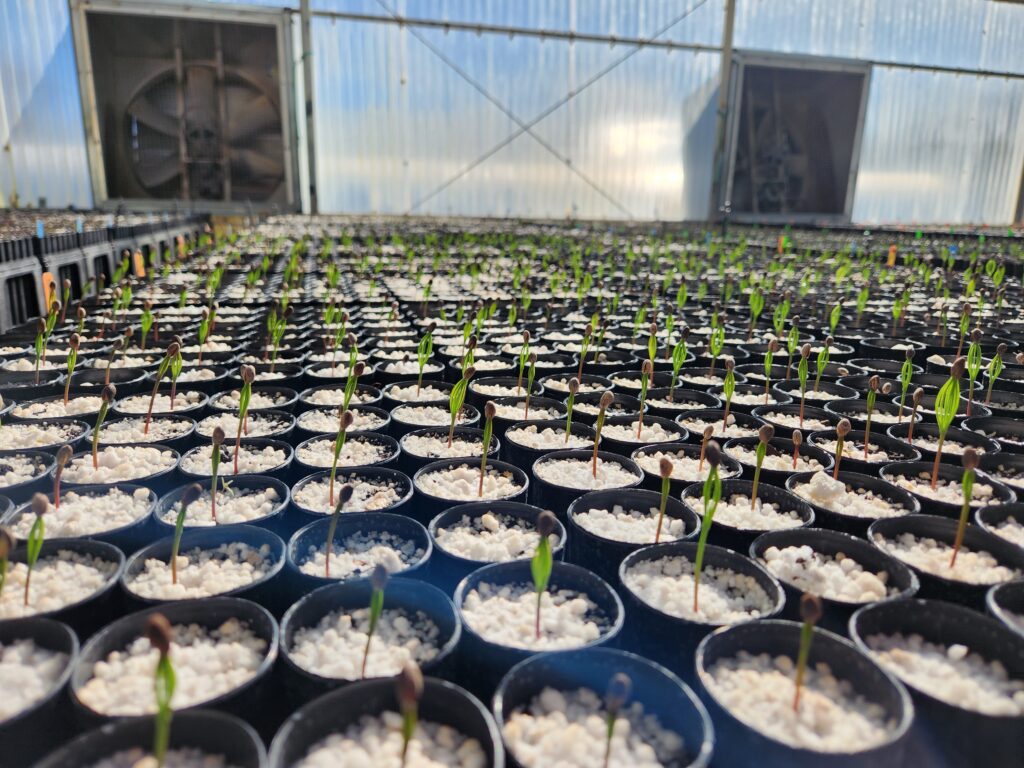
 Successful post-fire reforestation relies upon an adequate supply of high-quality, locally-adapted seedlings that are likely to survive and establish after transplant. In New Mexico, the vast majority of such reforestation seedlings are grown in the nursery at NMSU’s John T. Harrington Forestry Research Center (JTH FRC) in Mora. NMSU’s JTH FRC has been in operation since 1972 and in recent years has served as the de facto reforestation seedling nursery for the state of New Mexico. The JTH FRC has played an important role in training researchers and students from across the nation and around the world in nursery management, tree improvement, seedling ecophysiology, and reforestation science. They routinely collaborate with faculty of partner universities, as well as state, federal, and tribal agencies to use research-based approaches to develop new knowledge, plant materials, and techniques to help continually improve reforestation outcomes and solve our nation’s most pressing reforestation challenges. Under Dr. Owen Burney, the JTH FRC’s current director and a professor at NMSU, the JTH FRC is playing a leading role in meeting New Mexico’s need for large numbers of reforestation seedlings. Although the JTH FRC’s current seedling production capacity is approximately 300,000 seedlings per year —well below the needs of the state — the JTH FRC’s location in Mora was recently announced as the site of the NMRC’s new nursery. This new, state-of-the-art nursery facility will have a production capacity of five million seedlings per year, almost 17 times the state’s current capacity. Many of these seedlings will be distributed to landowners and communities impacted by fires through EMNRD’s Conservation Seedling Program or similar wildfire-specific programs that may be established as part of the NMRC’s operations to improve landowner access to high-quality reforestation seedlings.
Although this increase in capacity will put New Mexico on a much better trajectory to meet its reforestation needs, significant logistical and economic challenges remain. If we again assume that New Mexico needs somewhere in the range of 150-390 million seedlings to overcome its post-fire reforestation backlog, this would translate to approximately 30-78 years’ worth of this new facility’s full production capacity (at an estimated seedling cost of $225,000,000 – $585,000,000 in 2024 dollars if we assume an average cost of $1.50 per seedling) just to catch up with the current backlog, not including reforestation needs resulting from future fires. Although seedling costs can vary widely by stocktype and from one nursery to another, it is important to remember that not all seedlings are created equal. A nursery’s production practices, quality of seed, and materials used to grow the seedlings, and handling and shipping practices all significantly impact the survival and performance of seedlings, in addition to their cost. As with many things, in reforestation, you get what you pay for. Seedlings produced by the JTH FRC and NMRC, when incorporated into a Target Plant Concept approach that combines improved seed sources with improved nursery and planting practices, have been found to improve survival and performance on harsh sites in New Mexico compared to historically reported outcomes. Additionally, a major benefit of integrating the NMRC with the JTH FRC and other university partners is the ability to integrate cutting-edge university research with the NMRC’s operational scale seedling production in a way that allows for continual improvement and innovation in the NMRC’s seedlings and operations based on feedback from landowners, community and agency partners, and formal faculty research. This iterative, feedback-based approach to troubleshooting is a key aspect of the Target Plant Concept and should be a foundation of any reforestation program.
At this stage, there are several ongoing projects investigating the use of nursery cultural practices to enhance seedling quality and improve adaptability and survival on harsh post-fire sites. These include studies evaluating the use of drought-conditioning of seedlings in the nursery, different seedling stock sizes to identify optimal stocktype options for different sites and soils, investigating the impacts of seed source genetics on ponderosa pine seedling quality and performance, and the potential for locally-produced materials such as biochar to serve as components in nursery media mixes for seedling production. These research efforts are led jointly by NMSU, NMHU, and UNM faculty, along with graduate and undergraduate students being trained to serve as the next generation of reforestation scientists, and often with the assistance of and in collaboration with landowners, and community, agency, and NGO partners. Such research is critical to the continual improvement of nursery practices and the production of high-quality seedlings, but even the best seedlings grown from the best locally-adapted seed sources must be transported, handled, and planted properly in order to ensure the greatest likelihood of success for a reforestation operation. For this reason, the NMRC is also focusing on the improvement of planting research and operations in the Southwest.
Planting Practices
Although most reforestation planting operations in New Mexico have been, and will continue to be, performed by contractors working for landowners, the NMRC and its partners have long been engaged in research and outreach to identify and share climate-adapted planting practices likely to improve seedling survival and performance during post-fire reforestation. When planning a reforestation planting operation, one must ensure that seedlings are being planted on favorable microsites (e.g., small, sheltered areas of better, higher moisture content soils on a site likely to improve seedling survival) using the best tool for the seedling stocktype and the soils on the planting site (e.g., using planting bars rather than hoedads, which are good planting tools for the deep moist soils of the Pacific Northwest but entirely inappropriate for the shallow dry soils of the Southwest), that seedlings are being planted during a time of year when there will be good soil moisture on the planting site during and after planting, and that seedlings are transported, handled, and stored appropriately throughout the planting operation in order to ensure that planting stock quality is maintained and not lost through exposing seedlings to high temperatures, excessive drying prior to planting, or rough handling. However, in addition to these comparably well-established considerations, the NMRC is investigating novel approaches to reforestation, such as nucleation planting. Nucleation planting is an experimental approach which mimics observed patterns of natural regeneration by focusing planting efforts on the more favorable parts of planting sites where seedlings will have a better chance of survival. This creates a mosaic that can rapidly re-establish groups of trees across a burned landscape that can serve as a seed source for natural regeneration of surrounding unplanted areas in the future. Research into nucleation planting and planting densities is being combined with experimental remote-sensing-based seedling survival probability models developed by UNM’s Drs. Matthew Hurteau and Christopher Marsh that offer the possibility of identifying which parts of a site to focus reforestation nucleation plantings on and which to set aside for natural regeneration. While still experimental, these approaches offer the potential for more efficiently reforesting a greater number of burned acres by focusing planting efforts where they are most likely to be successful by improving post-transplant seedling survival. Other areas of active research include the impacts of using nurse objects like logs and shrubs to improve seedling survival, as well as the use of browse prevention devices (e.g., “tree tube”) to protect seedlings from herbivory. The NMRC is in the process of combining existing reforestation science with the findings from this research as they come available, all of which is being developed into a set of updated reforestation best management practices specific to New Mexico. The NMRC began offering reforestation planning and tree planting workshops for landowners in 2023 conducted by NMHU staff and often hosted on reforestation sites belonging to community members, and we will continue to share this information with landowners and agencies through both new publications and additional workshops in 2024 and future years.
Conclusion
Historically, most reforestation in New Mexico and the Southwest has followed a “plant and walk away” model, where seedlings were planted with little planning and minimal post-transplant follow-up or monitoring. However, this approach is outdated, has been shown to invite failure, and is not appropriate for reforestation of harsh post-fire sites in the Southwest. Given the high costs of reforestation associated with seed, seedlings, and planting, landowners and communities impacted by wildfires should make every effort to employ the principles of the Target Plant Concept to plan and execute their reforestation operations in order to ensure they maximize their chances of reforestation success, make the best use of their reforestation investment, collect the data needed to learn from their successes and mistakes, and put their forests on the fastest and most direct path to post-fire recovery.
Additionally, landowners and reforestation practitioners should consider the following points in order to improve success: 1) use locally-adapted seed sources, high-quality nursery seedlings, and appropriate planting tools, techniques, and timing; 2) early and effective planning and communication among all stakeholders is essential for reforestation success; 3) the economics of reforestation operations should examine the cost per surviving seedling rather than just the price tag of seedlings and planting operations, thereby emphasizing performance and quality rather than focusing on quantity alone; 4) research, education, training, adaptive management, new economic models and funding sources, and integration across all stages of the reforestation pipeline are all needed to maintain ponderosa pine forests in New Mexico.