

Soil and Water: The Harvest of Additive Conservation
By Karina Puikkonen
Originally published in Resilience, Issue #46 – Colors of Home

In 1995, Colorado Cattlemen’s Association members planted the seeds of a unique land trust model for conserving agricultural land, rooted in the belief that keeping stewards on the land offers exceptional conservation outcomes. Since then, CCALT has partnered with Colorado landowners to place conservation easements on working lands across the state. With more than 810,000 acres conserved to date, these lands ensure the continuation of open spaces, healthy ecosystems, and vibrant agricultural traditions across the state.
Agricultural producers have long lived by the rhythms of sowing, cultivating, and harvesting with the seasons, adapting and enhancing their lands progressively with each passing generation. Ranchers, while anchored in raising livestock, describe their profession as in “the business of growing grass”; they recognize that the true harvest lies in the health of its soils, its waters, and its diverse ecosystems that sustain their land.
To honor this land ethic, CCALT launched its Additive Conservation Program in 2021 to empower agricultural land stewards and enrich the vitality of their lands, ensuring richer soils, cleaner waters, and a more abundant future. “Agricultural stewards have always known that healthy land is the key to success,” said Brendan Boepple, director of conservation at CCALT. By bridging essential funding with technical expertise, the program enables landowners to nurture the living foundations of their operations, leading to improved soils and thriving local ecosystems.
Down the Rabbit Hole
Grady Grissom began his cattle operation on the plains of southeast Colorado in the late 1990s, planting the first seeds of his ranching journey with a focus, like most, on his cattle.
“In the first five years, I would show people my cattle. That is what I wanted to talk about,” Grissom said.
However, while running a cow-calf operation in those early years, Grissom discovered that the roots of success ran deeper than he first realized. In that moment, he realized that his land was not just the setting for his cattle but a vital partner in his success. With a growing interest in ecosystem health, he began nurturing both the land and his cattle. This led to a decade of improved cattle health and forage production, which allowed Grissom to increase stocking rates with 95 percent breeding success. For this innovative stewardship, he received the Colorado Leopold Conservation Award in 2017.
Grissom began exploring soil science after a workshop led by Nicole Masters of Integrity Soils, where she highlighted the relationship between soil, ecosystems, and water capture and storage. Inspired by Masters’ workshop, Grissom dove deeper into the subject and, along with several other ranchers, partnered with CCALT in southeast Colorado.
“I’ve gone down a rabbit hole on soil science,” Grissom said.
With support from CCALT and in collaboration with Colorado State University Extension, Grissom learned how to analyze soil data to improve soil health in arid rangelands. “The microscope has helped me figure out what we’ve only been able to see above ground and have always wondered [about],” Grissom said. “The soil food web is broken with too many bacteria and not enough fungi, so my goal is to capture all the rain that hits the ranch, cycle the minerals and carbon, and get the right fungi back into the system.”
Grissom and fellow ranchers hope their data will reveal how various land practices may impact soil health, help guide management decisions, and generate new knowledge to implement and share with other ranchers.
Grissom doesn’t believe he is doing anything extraordinary. He believes that successful ranchers, multi-generational families, and producers who pursue conservation easements operate with a long-term vision for the land. For Grissom, improving land and water resources is a continuation of good ranching practice, sustaining the industry for the generations to come.
The Landscape Vision
Farther west, Wynn and Ryan Martens saw a field of opportunity on a conserved property in Gunnison County’s Ohio Creek Valley. As a fifth-generation rancher whose family advocated for significant conservation initiatives in Colorado, Wynn Martens has long been familiar with conservation easements. Wynn’s uncle, George B. Beardsley, was a rancher and a founding trustee of Great Outdoors Colorado (GOCO). In that role, he was integral in securing the Colorado Lottery funding model GOCO utilizes to preserve and improve open space, including private lands conservation throughout the state.
 Redden Ranch in the Ohio Creek Valley was conserved by the Redden family and CCALT in 1998 with funding support from GOCO. When the ranch came up for sale a few years ago, Wynn was reminded of her family legacy and childhood ranch in Douglas County. She could see the potential for enhanced landscape-scale conservation along the Ohio Creek Valley.
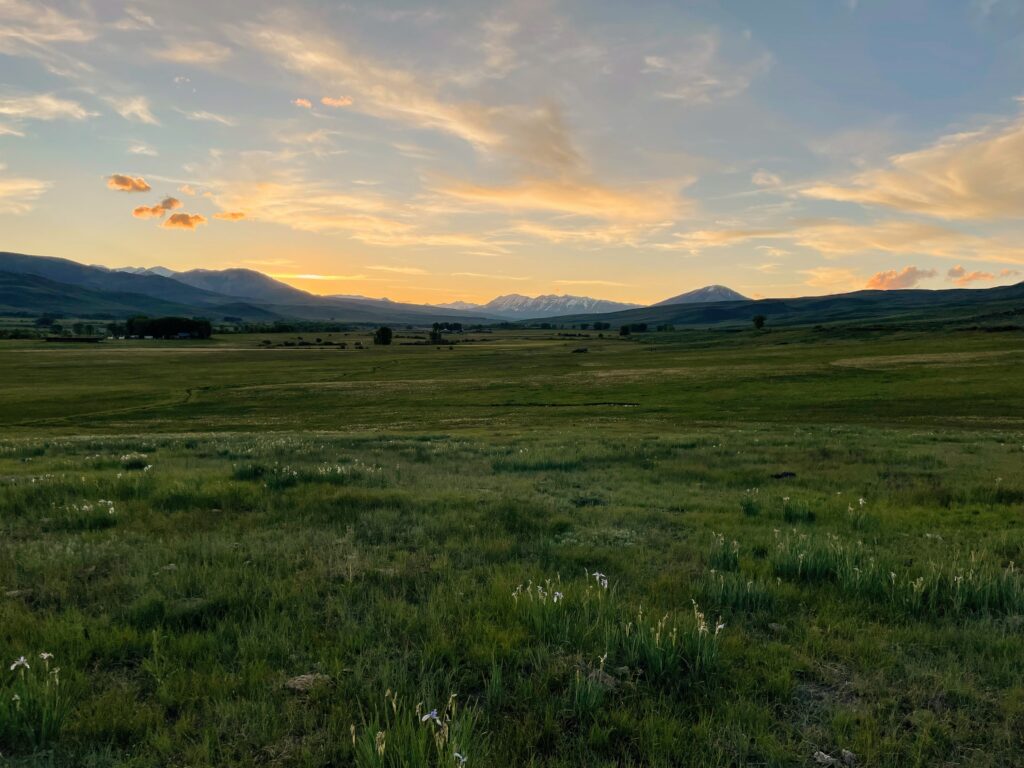
“This place is classic Colorado. It is one of the state’s prettiest mountain valleys, and people who live here seem very connected to preserving it,” Wynn said. “I love it because it’s so diverse –hay meadows on the bottom, sagebrush hills on the sides, and snow-capped peaks in the background.”
The Redden family’s conservation efforts were well-known in the region. The Martens seized the opportunity to build upon this legacy through regenerative grazing and wetland restoration projects. In 2012, The Nature Conservancy led a restoration project along Ohio Creek to repair eroded stream channels and breathe life back into the upland wet meadows – critical habitat for Gunnison sage grouse –by placing hundreds of stream restoration structures on surrounding public and private lands, including Redden Ranch. Years later, when touring the land with the same restoration team, they found the water had slowed, allowing it to seep back into the ground, enriching sediment and replenishing the groundwater.
Continuing their efforts in wetland restoration, water infrastructure improvements, adaptive grazing, and soil health initiatives, the Martens are cultivating not only agricultural productivity but vibrant biodiversity. With funding from CCALT’s Emery-Wilhelm Family Agricultural Resiliency Fund and the Upper Gunnison River Water Conservancy District, the Martens improved water distribution across the ranch’s meadows, ensuring a stronger, more resilient landscape.
“We are implementing a holistic management approach on the ranch. If the soil is healthy, everything else we hope to achieve becomes easier to accomplish,” Martens said. “We’re trying to support that system naturally.”
Like Grissom, Wynn and Ryan Martens trust the land to guide them, knowing that every observation, every project, every restored meadow is another successful measure for long-term resilience.
Collaboration is the Key
Modern land stewardship thrives in a culture of partnerships and common ground. Private ranches are part of wider ecosystems and watersheds managed by a variety of landowners and organizations. Partnerships and external support are essential ingredients in the stewardship of working lands.
“More partners and collaborations are always good,” Wynn said. “Continuing to be dynamic and additive is critical.”
For 30 years, CCALT has cultivated conservation in partnership with Colorado’s landowners. Today, the Additive Conservation Program continues to help land stewards plant new seeds of resilience, adaptability, and abundance on the lands they care for.
Ranchers like Grissom and the Martens help ensure the picture painted by working lands remains a living, breathing resource for the Centennial State. Looking ahead to the next 30 years, CCALT is honored to continue supporting those who understand that stewardship is not a one-time act, but an ongoing process – season after season, generation after generation.