


Rethinking and Returning Home
Jesse Pinkner
Photos by Phoebe Pinkner
Originally published in Resilience, Issue #45 – Searching for Home Ground
I know that it will sound cliche to start this by reminding you that “home is where the heart is.” But that phrase gives weight to the fact that, for 28 years of my life, a piece of my heart has resided on a small property in the panhandle of Texas. There, two square miles of land sit in the Wolf Creek Valley. Folks around there call this land the LZ Ranch. For many thousands of years, this land was home to the Native peoples of the Comanche and Kiowa tribes. This land still carries evidence of this history in the form of arrowheads, old dug outs, bison jumps, and even burial grounds. Local archaeologists have established that Wolf Creek and parts of the current LZ Ranch used to be very important trading, hunting, and farm grounds for many Indigenous people. And it is not hard to see why; to this day, the land is still covered in a delicate but fertile spur clay-loam soil that gives rise to sprawling fields of prairie clover, big bluestem, indian grass, and switchgrass, to name a few. This abundance of native grasses supports an abundance of wildlife such as bob white quail, sage grouse, white tail deer, mule deer, and bobcats, not to mention the flocks of wild turkeys that can reach numbers of 50 per group.
The LZ Ranch and LZ Hereford cattle company were established by my great-great-grandparents, Tom and Elvira Ellzey, in 1917. They had four boys who grew into ranch hands and ministers, and when these four married and began having children, the entire family started the LZ boys camp. This was a sleep-away style camp for young boys from the city to come to the ranch and learn about cowboys, campfires, hunting, music, poetry, and more.
Fast forward to the early 2000s; my brother, sister, and I were young kids from the city whose parents drove us from St. Louis to the LZ Ranch to see our grandparents once a year. We’d fly out of the car after pulling up under the elm trees, hug our grandparents, and then flee to the creek to start playing and wrestling like dogs. As my siblings and I grew into more capable people, we took on more responsibility during our yearly visits, saddling horses, branding calves, gardening, making applesauce, and more. Eventually an idea hit me: people live like this. Why can’t I?
***
 In high school I met Leah. We fell in love and throughout our college years, I would bring her to the LZ Ranch and teach her all of the things that I learned about the ranch when I was young. To my amazement, Leah loved these things as much as I had come to. You can probably see the question coming again but this time the two of us asked it a different way. People around here live like this; how can we make this happen for ourselves?
In 2021, at the height of the pandemic, Leah and I were living in St. Louis City. I was working for a nonprofit and Leah was working for St. Louis University extension studying plant biology. It was through her lab manager that Leah first heard about Quivira Coalition and the New Agrarian Program (NAP). Leah came home from work one evening with the email in hand from her manager outlining an “interesting program.” She read it to me and I think we both thought NAP sounded great. After all, NAP is meant to be a stepping stone for young people with little to no experience in agriculture. The prospect of getting to learn from experiencing these things first-hand is what got us so excited about the program. Still the doubt was hard to shake: why would anyone pick us to work at their ranch? Even though I had spent summers in Texas and Leah had a background in plant biology, we really knew nothing about ranching. We applied anyway and during the next three months of waiting for a response, we became obsessed with regenerative agriculture, determined that one way or another, we were going to be a part of this community of producers saving U.S. agriculture.
Leah and I were on a camping/rock climbing trip when, with what little cell service we had, we got a call. A rancher in central Montana was interested in having us work at his place. After a couple of virtual interviews over the next months, Leah and I packed up our house, fit everything we could in our Ford Escape and with our two cats and a dog, we drove 22 hours to Two Dot, Montana, population 26.
Over the next three years we changed into different people. Not to say that we lost who we were, but the community of apprentices in NAP that we now call our friends helped us to rethink everything we thought we knew about land stewardship, animal husbandry, industrial food systems, stockmanship, communication, and just how to be a good person in this new agricultural climate. It was learning from experts and making connections to other ranchers and mentors in the NAP program that we became confident enough to make another leap.
***
These days, the LZ Ranch is governed by my extended family as an undivided interest. This can be a unique challenge because of all the different opinions on the family council, but it offers a pretty incredible opportunity as well since there is always more than one way to solve a problem or build something new. Leah and I worked long nights after long days of ranch work in Montana to build a presentation for the family council. This powerpoint outlined the water cycle, cattle health, American rangeland history, intensive grazing management plan, low stress livestock handling, and more. To our delight, the family council was thrilled about everything we learned and were proposing to do at the LZ Ranch. After several arbitrations and tons of individual calls to family members, we signed a lease that keeps everyone involved and gives us the freedom to graze and manage the way we have learned.
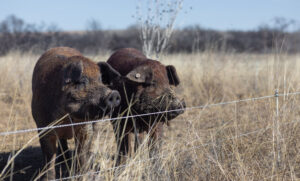
On November 1, 2023, Leah and I packed up all of our things once more and headed to the LZ Ranch. We drove for 20 hours this time, with a pickup truck and a stock trailer full of all of the tools we had accumulated for grazing over the past three years. We still had two cats and a dog, but in the back of the trailer were two pigs for breeding stock. We didn’t listen to music at all on this drive because we had so much to talk about: our hopes for the future, friends we were sad to leave behind, and the way we left ranching in Montana. After 17 hours, we were so tired we had to sleep in a Tractor Supply parking lot. The next day we woke up in a below-freezing truck and started the last leg of our journey home.
Pulling up under the elm trees this time was an almost unbearably emotional experience as we thought about all that brought us to this point, all of the hard work and planning. Even though they are gone now, it seemed like my grandparents were waiting for me under those elm trees once more but, this time to say “welcome home.” We opened the doors of the truck and had a moment to take in the smell of juniper and sounds of mourning doves before my brother and sister-in-law (who had moved to the ranch four months prior to start their own businesses) came barreling out of the house with music and a piñata to celebrate our arrival. Leah and I were both in tears.
Over the next 24 hours we began to take stock of where we were. In Montana, we learned from neighbors and friends that agriculture is a journey into peace and a labor of love. This lifestyle takes a tremendous amount of patience — with yourself, your community, and nature. We are always learning to be at peace with our changing environment and to meet it with the patience to respect it for what it is, yet all the while, determined to gently nurture its abundance and beauty. To look at the LZ Ranch with the eyes of beginning land stewards, we saw the degradation and decay but by looking at the marks of love left to us by relatives and friends, we were inspired to make this place into our home. We saw the bare wires hanging out of the ceiling and the plumbing fixed by 40-year-old duct tape, but it filled me up with hope and excitement to be here sustaining this place for the next generation.
After being at the LZ Ranch for three weeks, we found out that Leah is pregnant. Lately, I am filled with an incredible weight. To be on the property I have longed to live on since I was nine, to see my best friend and partner wandering around feeding pigs and building electric fences, pregnant with our daughter, is a feeling that is hard to describe. Most of the people in the generations before me who built this ranch into what it is today have never met me, Leah, or our child but it is their pioneering spirit that always made the LZ Ranch feel like home to me. And it is with that spirit that our daughter will come to call this place home.