

Remnants of Disaster: Recovering from the Hermit’s Peak/Calf Canyon Fire with NM Earthlings
Elaine Gonzales Mitchell and Feliciana Mitchell-Gonzales
Originally published in Resilience, Issue #45 – Searching for Home Ground
2022 was the sixth-driest spring ever recorded in New Mexico. The Calf Canyon Fire was caused by a holdover fire from a prescribed pile burn that was improperly extinguished, and lay dormant for three months under snow. The Hermit’s Peak Fire began as a prescribed burn on April 6 that simply went out of control, causing spot fires that quickly merged. On April 22, 2022, high winds caused the two fires to combine, ultimately becoming the largest forest fire in New Mexico’s history, crushing the record set by the Las Conchas Fire by over two times. The fire ravaged more than 341,700 acres of the northern portion of the state before finally becoming 100 percent contained on August 21.
Fast-forward to August 2023.
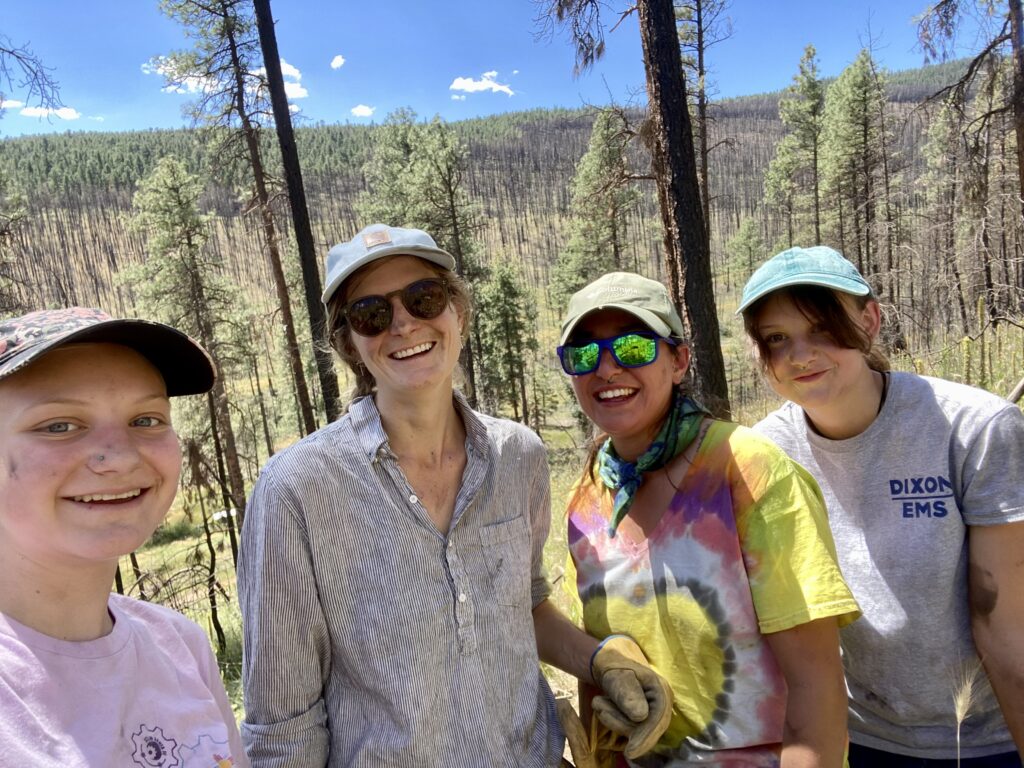
 As residents of communities impacted greatly by the fire, the members of our New Mexico Earthlings Youth Collaborative internship cohort knew first-hand of the damage the disaster had caused to the soil, water, ecosystem, and farms in northern portions of the state. The short internship took place in one such area: the town of Mora, a community hit hard by the most intense bouts of wildfire in 2022 and ravaged frequently thereafter by flash floods along burn scar areas. The internship was very eye opening; not only were we witnessing the damage to the surrounding landscape in the form of charred trees or ashy soil, we were also actively learning about other consequences of wildfire, ones that go a bit beyond the surface level, such as damage to vital tributaries, soil permeability, and the health of an entire watershed.
The New Mexico Earthlings Watershed internship is a three-day summer program dedicated to learning about the effects of the Calf Canyon/Hermit’s Peak Fire and helping with restoration work. We learned how to see the effects — such as destructive flash floods or hydrophobic soil — and be able to examine them as symptoms of the larger catastrophe. Alongside our wonderful internship leaders, Carmen Taylor and Claudia Reynoso, we were guided to connect the dots from fire to flash floods to the newly-sprouting mullein taking over every bare and charred hillside; we learned to trace the path between ash-filled watersheds to increasingly alkaline soil to sick wildlife and struggling plants. We also had the privilege to visit the largest seed storage bank in New Mexico and learned about their reforestation efforts in the state. We examined the plants and the soil quality of the areas affected most intensely by crown fire, and how uprooted and dead trees left disturbed, bare soil that gave home to specific plant species. One of the most fascinating things for us was how prescribed burns have been managed, and the efforts to plant and re-introduce native species to the vast areas affected by this catastrophe. We also began to understand how important fire actually is to the environment, and the necessity of well-managed, controlled burns. Although at the time the fire seemed very destructive and challenging, many plants, such as oak, could not survive without the help of fire to thin out tall conifer trees that block sunlight from reaching the forest understory.
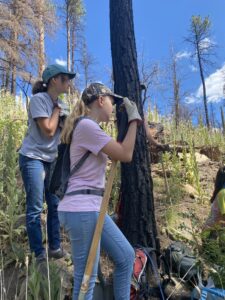
Although the internship was focused on the aspects of wildfire recovery as it pertained to the watershed and surrounding ecosystem, we had the opportunity to give back to the community members through a contour-felling service project. We worked on a badly burned slope to stabilize logs and rocks to serve as erosion control and to slow the flow of floodwater. During this project, we had the opportunity to speak to experts, such as Shantini Ramakrishnan, on how to prevent dangerous erosion that is caused by fire-damaged trees, which in turn produce mudslides and floods. The interns were even able to work with these specialists to build floodbreaks on a steep hillside overlooking a local resident’s property in an effort to prevent further damage.
The most impactful thing, for us, was the internship gave us the opportunity and platform to be able to educate ourselves on the real, contemporary issues that our rural communities face in the broad calamity of climate change, and how understanding smaller symptoms, such as increasingly severe regional wildfires, fit into this larger global shift. Just as the smoke blew across nearly the entire northern portion of the state that fateful spring, so do the effects of the fire permeate and echo through the soil, the streams and watershed, and the multitude of organisms that rely on these resources. Serving the Mora community and being a part of the restoration effort, being able to learn more about the impact of wildfires to ecosystems, public lands, and community members’ properties, was truly an amazing experience.
We can’t save what has already been burned and broken. But we can see the wildfire as an opportunity to renew the ecosystem, ease the pain and loss by working together, and help our rural New Mexican communities stand tall again.