

Our Stepping Stone
Bill Zeedyk
Originally published in Resilience, Issue #45 – Searching for Home Ground
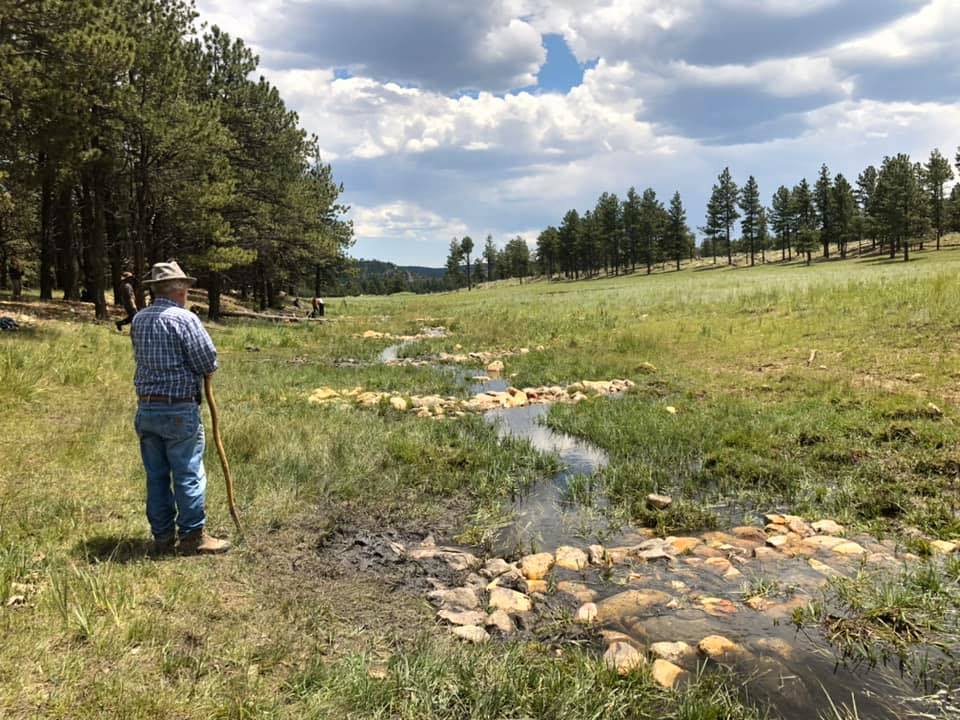
My wife, Mary Maulsby, and I purchased our land on Manuelitas Creek in San Miguel County, New Mexico in June 2004. We placed some rocks as stepping stones so that we could easily cross the creek for evening walks to watch the birds, the beavers, the frogs, and the turtles.
As newlyweds, we built our home, reorganized our business and moved from Albuquerque to the rural community of Cañoncito. The term “stepping stone” took on a new meaning, and we named our land Stepping Stone. Our new home overlooked the meadow with the creek, a neighboring beaver pond, with ponderosa pine woodlands in the background.
The pasture, next to the creek, had been heavily grazed by horses for many years. Except for many young sprouts and three very old apple trees, the meadow was well trodden. With a wildlife habitat improvement grant from the U.S. Fish and Wildlife Service, we fenced off five acres of streamside pasture, built some berms, redirected some flow across the former wetland area, and thinned some of the forest. The next year beavers moved in, along with some muskrats, meadow voles, snapping turtles, leopard frogs, bull frogs, nesting ducks, Canada geese, fish, great blue herons, black-crowned night herons, King fishers, and other kinds of wetland-dependent wildlife. The beavers built dams, dug waterways, and invited many species of willows, cattails, rushes, and dragonflies to join them. Lizards basking on the rocks in the sun would come drink out of the creek every day. Our five acres of wetland became a haven for wildlife. The horses still loved the remaining pasture, which produced many bales of hay each year. Many elk and deer also enjoyed the pasture each year.
Due to climate change, drought has affected our creek, and dried it up two summers in a row. We lost many frogs and fish from these events. There have been strange weather changes, such as a late freezing snow storm in mid-September one year, killing many hundreds of thousands of migratory birds, like swallows, warblers, bluebirds, robins, and such. Also, their migratory habitat is changing, so they don’t get what they need in their few stopping points along their way.
In 2016, the beavers on our land, and for many miles up and downstream, died of what we believe was tularemia, but which we couldn’t confirm. I found four dead beavers at the edge of their pond when the ice melted that March. Cottontail rabbits and jackrabbits disappeared from our valley that year, and still have not returned since that time.
Soon after the beavers died, the dam failed and the pond dried out. Hay crops in our meadow and down valley dwindled as the shallow groundwater that sustained the clovers and timothy grass ceased to flow beneath the meadow.
With the beavers and the wetlands gone, more than thirty species of wetland-dependent birds disappeared. Gone are the nesting ducks, the herons, the Kingfishers, turtles, the frogs, the sora rails, the sandpipers, and the snipe. Sad, but true.
For two months, starting in April of 2022, the Hermits Peak/Calf Canyon Fire burned our valley, and many other mountains and valleys in Northern New Mexico. It was the largest and most destructive wildfire in the state’s history, with more than 340,000 acres burned. Most of our watershed, Manuelitas Creek, and its tributaries, burned. Miraculously, our home survived, as did our barn, but some of our neighbors, both up and down valley, lost their homes, barns, outbuildings, vehicles, forests, and woodland landscapes. Up valley from us at Pendaries, nearly 50 homes, the hotel, the restaurant, and the community center burned. More than 800 homes in total burned to the ground. The fire burned to within six feet of our house, but fortunately we had the opportunity to come home from a week of evacuation for one day, and soak everything down – the house, decks, lawns, grasses, and shrubbery for forty feet around the house – before having to evacuate again for another three weeks. Compared to our neighbors, we were lucky. Our house was spared, though we did lose our RV and a pull-along camper, quite a few acres of trees, and lots of fencing.
Following the devastation in our canyon, the fire continued to spread to the west and north into the Sangre de Cristo Mountains and northward through Mora County, and into Taos County. Also southwest to Mineral Hill toward Pecos. Finally, the first heavy rains began on July 1. Here at home, we received 18 inches of rainfall between July 1 and October 3. The rains resulted in 11 floods, three of which were valley-wide, flooding our barn and closing our road, and many other roads many times. Huge sediment piles and debris rendered the roads impassable for days at a time. Our pasture was covered with debris coming down canyon in the floods, and down from the county road south of us. In many ways the impacts of the floods originating from the severe burn areas were worse than the fire itself. Many people’s homes flooded. More than 2,000 feet of our boundary fences were destroyed by the floods. Many hundreds of tons of sediment and organic debris were deposited on our meadow – some good, some bad.
We lost many elk, birds, lizards, frogs, fish, and mammals to the fire.
 In 2008 and 2009, Mary and I had thinned about 30 acres of our ponderosa pine forest, using a grant from New Mexico Forestry for the purpose of improving tree growth, reducing the risk of fire, and improving wildlife habitat. The dominant tree stand was about sixty years old, resulting from wildfire and natural reseeding in the 1940s. We worked with the New Mexico Forestry extension forester to lay out the area to be thinned and agreed on thinning guidelines to be followed. Maintaining and improving wildlife habitat features and components was an essential aspect of the thinning treatment for us, so the guidelines we followed were more complex than normal. We wanted to maintain denser stands of trees than is the norm so we thinned to a stocking level of 80 acre square feet of basal area per acre, rather than 60. Instead of removing standing dead trees, called snags, we left standing at least two dead trees per acre for cavity nesting birds, like woodpeckers, flickers, nuthatches, chickadees, bluebirds, violet green swallows, and wrens. To maintain a good population of Abert’s squirrels, we left scattered patches of six to twelve pole-sized or larger ponderosa pines with interlocking branches intact.
As a very special feature, we left a corridor of dense ponderosa pines leading up a narrow ravine, from the valley to the ridgetop intact. This provided a travel way for female black bears with cubs. This also provided cover for deer and elk.
The bears come to enjoy our apples and acorns each October. We enjoy seeing them, even in the apple trees.
Our thinning guidelines worked. When we thinned the forest, the fuel load was reduced. Even though our pine stand occupies a dry, south-facing slope, the Hermit’s Peak fire stayed at ground level and did not “crown out.” Our forest thinning operation from 2009 saved our forest in 2022.
Of special value, as a unique habitat feature was a very tall, thirty-inch diameter pine snag. Riddled with abandoned flicker cavities,it was nesting habitat for at least thirty pairs of violet green swallows. A very special place. Every evening, as the sun set, the swallows would fly back and forth over the beaver pond searching for insects for their young. Sadly, the fire destroyed the snag. A few lone swallows return each year, but nothing like the couple of hundred that came in previous years. They are sorely missed.
Climate change has also hurt our animal population. We had two years in a row that the creek dried up completely. Our population of fish and frogs started their decline then. Also an unprecedented mid-September snow storm froze many migrating songbirds or starved them when their food, the insects, froze.
Many of our bees have been lost to chemicals such as glyphosates, used elsewhere, so there are fewer flowers with no bees to pollinate them. We are, however, noticing new little pollinators, such as the red belted bumblebee.
A long, narrow, eight acre, nearly pure stand of thirty-to-forty-foot tall Gambel’s oak trees produces a bumper crop of acorns nearly every year. The oaks are growing on moist soil at the very foot of a north-facing slope. Our home is in the oak stand, which is partly on our land and partly on our neighbor’s land. Many species of wildlife are attracted to our patch of acorns. Not only bears and Abert’s squirrels, but also mule deer, elk, wild turkeys, red squirrels, and many species of birds.
We are so grateful that our oak stand survived the fire. Most of it unburned or mostly unharmed where it did burn.
Recovery of the burned area is ongoing, especially in areas not damaged by the crown fire. Much recovery will happen by natural processes, but some recovery will not occur without human assistance. The upstream migration of native fish species that were eradicated by the floods is blocked by irrigation diversion dams. Restocking will be necessary, not only for missing fish species, but also for missing frogs, turtles and other species, if natural species diversity is to be restored. Thousands upon thousands of acres of ponderosa pine forest need to be replanted. What other plant species are also now missing? Who will accomplish the restoration efforts and how will it be paid for? Or will it never happen?
The Natural Resources Conservation Service (NRCS) and the Federal Emergency Management Agency (FEMA) have been very cooperative with us in designing, processing, and awarding the funding to undertake recovery work. We are happy with their assistance and the funding process we have experienced. We have been compensated for our fire-and flood-related losses, and have initiated repair and recovery efforts. We will rebuild three miles of burned and flood-damaged fences. We have hauled away the remains of our RV and our camper. We will reconstruct our badly eroded driveway, damaged by flood runoff from the burned area, and we will build a berm around our severely flooded barn to protect it from future flood flows. We are building a structure to save our outbuilding from flooding. With help from the NRCS, we will rebuild our totally destroyed irrigation system. We will also dig away all the road debris (about two feet deep over about eight acres). We will restore damaged wetland.
We are very, very grateful that our home survived the fire, and that we still have our trees that survived. Mary and I will sit on our deck in the evening and watch the sunset and the moon rise. Now that all the helicopters have finished their tasks and are no longer flying over the house, we can listen for the great horned owl to hoot and the robins to tell each other goodnight. The gratitude we feel for the survival of our house is immense. Other things can be replaced, repaired, and forgotten. Stepping Stone is still here!