

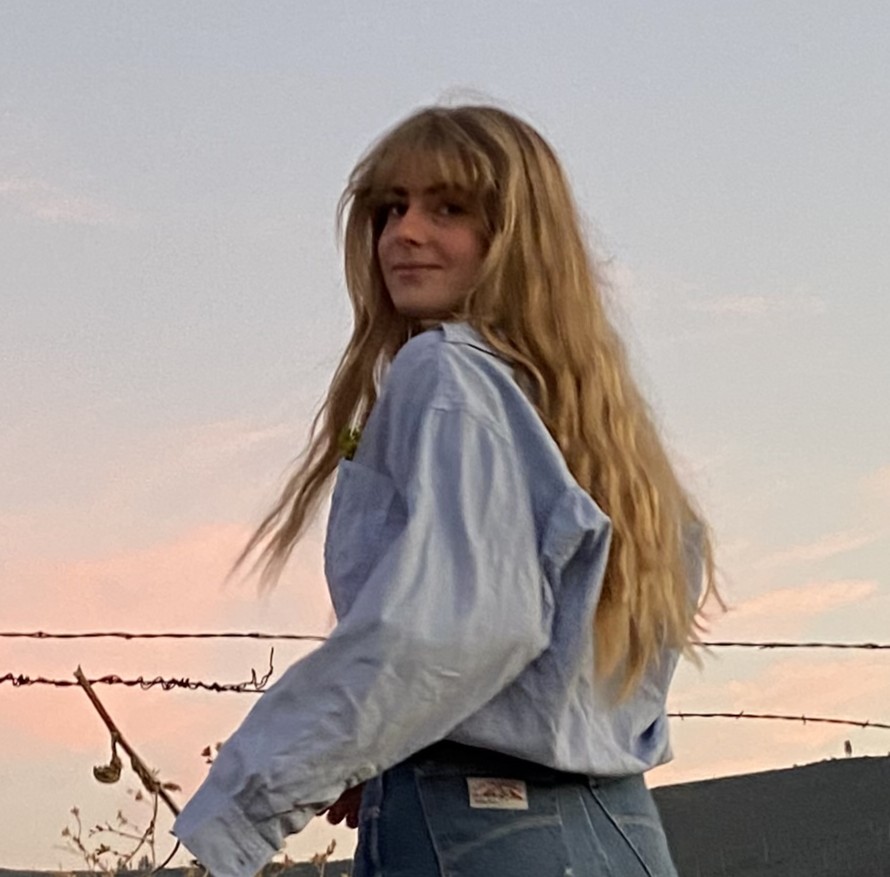
How did you get interested in agriculture? And what are you hoping to gain from your apprenticeship?
May 2025
I wanted to ride horses in pretty places. I looked into working as a wrangler, but I was concerned that leading a string of whining children behind me would take away from the experience. So ranch work it was. I managed to get a job on a small ranch in Central Oregon despite having no experience aside from working at horse barns. This path of course, brought its own set of challenges. It is far from the romanticized version that’s typically put on display. I moved endless handlines, fed in negative temperatures and pulled dead calves out of irrigation ditches. There were a lot of hard days. But what you learn with ranching, is that every bad moment is paralleled with one that is beautiful. This work allows you to observe the subtleties of nature that you would typically miss while just out on a daily walk. I have seen the surrounding mountains where I’ve worked illuminated in every shade of light, shrouded in fog or barely visible through an oncoming storm. I’ve worked closely alongside wildlife, witnessing bold displays of their natural behavior. In this work you are not merely just a spectator; you’re fulfilling your own role on the land. The animals seem to recognize that.
Perhaps though, the most fulfilling aspect of this work for me is the importance it holds. To people, the land, and the animal. I grew up dreaming of one day owning an animal rescue, and now I find myself working in the very industry I used to condemn. But I feel good about the work I do. I spend each day tending to happy livestock on land with flourishing ecosystems. I watch how they support one another, and in turn produce nourishing food for families. It is a privilege to hold a role within the system, and to be able to ensure that things are done in a way that allows me to feel proud of what I do.
As I continue with this work, I hope to find a place of true belonging. A place where my strengths can be applied to uphold the highest standard for the quality of life of the animal, while simultaneously caring for the land they are raised upon. Everyday since beginning this apprenticeship I have watched the balance struck between nature, human and animal. It is encouraging to see, and an even greater privilege to participate in.
Final Reflections
November 2025
Meadows of wildflowers, forests that turn golden, and clear blue rivers rushing through. All surrounded by snow capped mountains that reflect pink with the rise and fall of the sun. The Roaring Fork Valley has everything, and within it- a strong history of ranching. It is a valley that is trying to turn its back on its roots with every new subdivision that is built, and the grand opening of each new store. Every luxury must be at its fingertips. A valley of opulence and ignorance. Mount Sopris rises over it, a mountain that once overlooked a quiet town surrounded by cow pastures, now presides over developments, creeping closer and closer to her base, all competing for a view. She tries to hold enough water for us, but what she’s watching isn’t just here- it’s everywhere. And the world is getting hotter. She watches a community that is forgetting it would be nothing without ranching. The local grocery store is surrounded by cow pastures. Yet the connection between the two is somehow lost. The ranchers are running the rivers dry- they accuse, as they look past the golf course that has managed to stay green throughout the driest July on record. The wolves are afforded more protection here. But the ranching community is strong in this valley, and every summer the cows march through town to briefly remind everyone.
The parade through town is only a glimpse into the life. (Although this previous spring it could have been considered more of a show when we lost half the herd in town.) Everyone knows when the cows make their yearly trek up to the forest, but they don’t see the miles of fence that is put up to prepare the mountain for the 900 pairs of cattle headed its way. Or the days spent riding the permit, herding the cows to greener pastures. Following the cows will lead you through Aspen forests that reflect gold, into meadows of wildflowers, and up to views of the entire mountain range. And then to humble you they will pull off the trail, and take you down through some of the worst country you’ve ever ridden. Between stubborn cows and a coworker who didn’t believe in trails, I rode through my fair share of unforgiving oakbrush, and down hillsides that could hardly be differentiated from cliffs. Throughout the summer the forest slowly began to morph into a shape that made sense, I learned the trails through its vastness, and uncertainty was replaced with appreciation.
When the days become shorter and the mountains begin to receive their first snowfall, the cows make their way down. People line the streets handfuls of grass in hand, to welcome them home, and they are once again reminded of the presence of ranching within the community. The cows eventually trail out of view, taking all the responsibilities with them. The ranchers follow after, calculating how long the pastures they’re heading to will hold the herd, hoping to not have to prematurely pull from the stockpile of hay they spent the summer harvesting. And the calves still need to be weaned and vaccinated, as shipping day is nearing.
To know more than just when the cows come home is a privilege. In my time at Cold Mountain Ranch, I have been involved in every season of work, starting with calving season. Every morning started with walking the pastures as the sun came over the mountains, and greeting each new calf with a yellow tag. I was fortunate to befriend a couple of the calves, they were good company for picnics, and made nice pillows for naps. They were sent off to the forest with lectures about purple flowers and wolves, and greeted with peanut butter cookies when they ambled their way back down this fall. Even in the absence of the cows over the summer, the work at home didn’t cease. The hayfields demanded just as much attention as the herd had. Early morning calf checks were replaced with walks out to irrigate, scattering herds of elk along the way. By July, the fields had enough water to their satisfaction and the grass stood tall, ready for harvest. I spent a couple weeks in the tractor raking, baling and stacking- an activity previously unfathomable to me as I’m usually great at avoiding large equipment. However, aside from a lost diesel cap and a couple of mauled bales, nothing was wrecked, and there’s enough precariously stacked hay to get us through the impending winter. It’ll be a quiet season- hay will be doled out, and everyone will rest before it’s time to raise up the next crop of calves that’ll make their way through town to once again remind this valley what it has been built upon.