

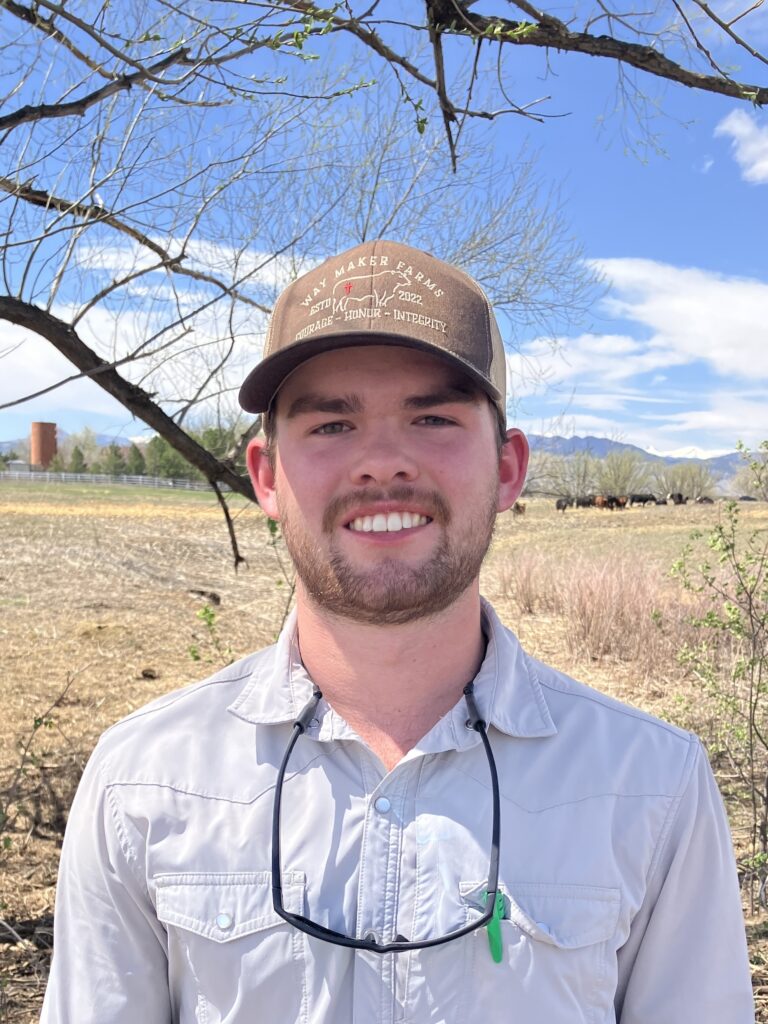
How did you get interested in agriculture? And what are you hoping to gain from your apprenticeship?
May 2025
I was born and raised in North Carolina, and for as long as I can remember, I have always been interested in agriculture. Most of my early agricultural experience was at one of my good buddy’s farms, where we would plant food plots, raise pigs, and a few chickens. I always loved going there to help and learn how to raise and take care of livestock.
With that being said, it was always my dream to work on a large-scale beef cattle operation. I went to North Carolina State for Agricultural Business Management, originally in the four-year program, but after a summer as a wrangler at a dude ranch in Colorado, I knew I couldn’t wait three more years to start working with cattle full-time.
I ended up switching to the two-year Agricultural Institute at N.C. State, and shortly after the semester started, I began looking for jobs working with cattle out west. I came across the Quivira Coalition and filled out my application immediately. After a few interviews, I was hired on at Elk River Livestock for the summer of 2025.
After the first few weeks at Elk River, I have already learned a ton, and I’m looking forward to gaining a better understanding of grazing management, livestock handling, and improving my horsemanship.
Final Reflections
November 2025
Before becoming an apprentice at Elk River Livestock through the Quivira Coalition, I didn’t know much about regenerative ranching or the impact it had on the land. The idea of managing land in a way that improves it was something I didn’t know much about. When I started the apprenticeship, I wasn’t sure how interested I would be in this type of grazing, but it didn’t take long for me to realize that it was something I wanted to dive into. I quickly decided that I wanted to learn as much as I could.
Over the summer, I learned a ton about ranching and land stewardship. Every day offered a new challenge and opportunity to learn something new. I learned skills like fencing, roping, working with livestock, and even starting colts. I also learned when and how to move cattle to promote healthy forage growth and soil recovery, which is one of the main focuses of regenerative ranching. Doing this taught me how important timing, observation, and adaptability are to a successful operation. I came to appreciate how beef cattle can actually improve the land over time. This is something I had never thought about before.
One of my favorite parts of the apprenticeship was the community. Early in the summer, we went to brandings at neighboring ranches, at the brandings I learned to flank calves and got to experience the traditional way of branding cattle. After the brandings, there would usually be a cookout where everyone would hang out after. Going to these brandings helped me meet many people in the valley and build relationships that I know will benefit me throughout my career.
On weekends, I often went into town for the Steamboat Rodeo, which was always a great time. I would hang out with some buddies I had met in Clark and others from a ranch I had worked at previously. It was nice to have a good size town close by to transition from being in a busy college town to a rural community.
This experience at Elk River Livestock has inspired me to pursue a long-term career in beef cattle ranching, specifically one that focuses on regenerative grazing practices. I’ve seen firsthand how intentional management can lead to healthier soil, more productive pastures, and more resilient ecosystems. I want to be part of that movement and be apart of ranching methods that sustain the land.
This winter, I’ll be heading to South Dakota to work on a ranch near Wall. I’ll be there until late April, gaining new experiences and learning how different operations handle their grazing systems. After that, I plan to return to Colorado for a second year with the Quivira Coalition at Elk River Livestock. I chose to come back because the program offers great resources and mentorship. For example, the supplemental education calls they host once a month feature guest speakers who cover a wide range of topics from building healthy soil and managing finances to starting your own ranching business. These sessions have expanded my knowledge far beyond what I could learn just from hands-on work.
Looking back, this past summer was one of the most meaningful experiences I’ve ever had. It gave me practical ranching skills, a strong network of mentors and friends, and a clearer vision for my future in agriculture. I’m excited to continue learning, growing, and doing my part to make ranching more sustainable for generations to come.
Before becoming an apprentice at Elk River Livestock through the Quivira Coalition, I didn’t know much about regenerative ranching or the impact it had on the land. The idea of managing land in a way that improves it was something I didn’t know much about. When I started the apprenticeship, I wasn’t sure how interested I would be in this type of grazing, but it didn’t take long for me to realize that it was something I wanted to dive into. I quickly decided that I wanted to learn as much as I could.
Over the summer, I learned a ton about ranching and land stewardship. Every day offered a newchallenge and opportunity to learn something new. I learned skills like fencing, roping, working with livestock, and even starting colts. I also learned when and how to move cattle to promote healthy forage growth and soil recovery, which is one of the main focuses of regenerative ranching. Doing this taught me how important timing, observation, and adaptability are to a successful operation. I came to appreciate how beef cattle can actually improve the land over time. This is something I had never thought about before.
One of my favorite parts of the apprenticeship was the community. Early in the summer, we went to brandings at neighboring ranches, at the brandings I learned to flank calves and got to experience the traditional way of branding cattle. After the brandings, there would usually be a cookout where everyone would hang out after. Going to these brandings helped me meet many people in the valley and build relationships that I know will benefit me throughout my career.
On weekends, I often went into town for the Steamboat Rodeo, which was always a great time. I would hang out with some buddies I had met in Clark and others from a ranch I had worked at previously. It was nice to have a good size town close by to transition from being in a busy college town to a rural community.
This experience at Elk River Livestock has inspired me to pursue a long-term career in beef cattle ranching, specifically one that focuses on regenerative grazing practices. I’ve seen firsthand how intentional management can lead to healthier soil, more productive pastures, and more resilient ecosystems. I want to be part of that movement and be apart of ranching methods that sustain the land.
This winter, I’ll be heading to South Dakota to work on a ranch near Wall. I’ll be there until late April, gaining new experiences and learning how different operations handle their grazing systems. After that, I plan to return to Colorado for a second year with the Quivira Coalition at Elk River Livestock. I chose to come back because the program offers great resources and mentorship. For example, the supplemental education calls they host once a month feature guest speakers who cover a wide range of topics from building healthy soil and managing finances to starting your own ranching business. These sessions have expanded my knowledge far beyond what I could learn just from hands-on work.
Looking back, this past summer was one of the most meaningful experiences I’ve ever had. It gave me practical ranching skills, a strong network of mentors and friends, and a clearer vision for my future in agriculture. I’m excited to continue learning, growing, and doing my part to make ranching more sustainable for generations to come.