

Horno
By Leeanna Torres
Originally published in Resilience, Issue #46 – Colors of Home
It was late October, and cooler air was finally setting into New Mexico; I’d sent Oliva a text, asking “will you be in Taos this weekend?”
I’m actually going to be there Saturday afternoon to Sunday afternoon, she replied. I’d love for you to come by! We’re doing a cultural interview with my parents about the Renaissance of Adobe Architecture in Northern NM. We will be filming at our home in front of the horno we built. I can send you directions…
So Oliva sent directions, but the GPS in the car wasn’t familiar with the winding roads of Llano Quemado in Taos, and led me the wrong way, even into the wrong yard. A slow-moving car, dirt road after dirt road, trying to find the way.
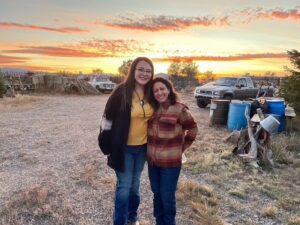
But finally, as afternoon waned, the color of Mr. and Mrs. Romo’s yard came into full view. Fading scrap wood piled neatly and stacked for re-use or burning, and pallets bleached grey by summer sun. A slate-metal wheelbarrow turned upwards (so the tire won’t go flat and rain won’t gather like a puddle to rust its bucket). Two old-work trucks, a single-cab Chevy, faded blue, and a powder-grey Toyota, extended cab. Something in me smiled because so much of the yard was colored familiar to my own childhood home. As the colors of a working family’s yard greeted my entrance, at last I spotted Olivia.
“Eeee, mana, que hay de nuevo!” she greeted, stepping down from the home’s front-door steps. And as we embraced, two friends not having seen each other in quite a while, the horno stood stately by the house.
***
Pronounced “orno” (with a silent “h”), these outdoor beehive-shaped ovens have been crafted and used by Southwest Pueblo and Hispanic communities alike; these functional ovens have become iconic symbols of century-long traditions within New Mexican culture. Tewa-speaking Pueblos call it pante, which means ‘bread house.’ Constructed most commonly from adobe – traditional hand-made mud bricks – many hornos are then plastered over with more mud mortar or mud plastering. These hand-shaped earthen ovens grace the yards of rural homes in and around communities of NuevoMexico.
Native New Mexican artist and enjarradora, Anita Rodriquez, revealed, “…the history of the horno is layered, a long story of cultural conflict and confluence that began in the Middle East, traveled to Spain, and then to this continent.”
And with a resurgence of interest and appreciation for traditional adobe building techniques and styles – characterized by a return to such techniques as using adobe as a building material, incorporating elements of Pueblo, Spanish Colonial, and territorial architectural styles – the tradition of building and utilizing hornos in and among New Mexico families remains str ong, often passed down generation to generation. Thus, the presence and use of the horno colors our New Mexican culture and traditions with its functionality, with its contemporary use.
***
“Come in, come in,” offered Oliva, inviting me into her childhood home as the afternoon wanes. Inside, more familiar colors – framed family photographs like confetti on the walls, a couch with blankets draped over the top.
“Hello again,” I say to Mrs. Romo, who’s inside the kitchen, and she offers me a hug instead of just a hand; her embrace is warm and wide, as though she’s known me for years rather than meeting me just once at one of Oliva’s poetry workshops.
And seated at the far end of the kitchen table is Mr. Romo, one hand steady on his bordón (walking cane) even as he remains seated. His place at the table reminds me of where my Nana used to sit in her older years, a place at the table where one can easily see both through the window to the outside, as well as directly into the kitchen. A seat of strategic viewing, a place to see all the ongoings both inside and out.
Mr. Romo asks me where I’m from, quien soy. Explaining I grew up in the farming area along the Middle Rio Grande Valley, a community called Tomé, he nods his head, and his eyes light up as I speak to him in New Mexican Spanish, relaying family names.
“Comen, comen, (eat, eat)” motions Mrs. Romo, waving her hand over to the kitchen counter, “there’s plenty, anda come and eat.” On the stove sits a big pot of beans, and next to it, a puela with red chile. Picture also little bowls with garnish – mint-colored shredded lettuce, yellow sharp cheddar cheese, and a bowl of Frito-Lay Fritos. Classic New Mexican Frito Pie.
There is something about a shared meal, an invitation to eat. I remember the ceramic red and yellow of Mrs. Romo’s plates, the cream white of her kitchen’s window curtain above the sink, the tint of holy apricot in the generosity she offered.
***
As I eat at Mrs. Romo’s table, an easy Saturday evening conversation, I wonder at all the family and friends they’ve welcomed to their table. Oliva asks me how work is going, and I ask her how living in Santa Fe is treating her.
What makes a feast? What defines a friend? And what cultural traditions meld us together tighter than adobe itself?
“Hola mana…” is often the greeting received when my comadre Oliva answers the call. Most times it is just to check in, just to platcar, shoot the shit or else simply see how one another is doing. It’s a simple thing – friendship – yet its essence colors my ordinary days like the verde of alamo trees along our dusty, high-desert landscape.
***
“We built the horno one summer,” explained Olivia. “I was about twelve…my dad just really wanted to have our own horno where we could cook the meat we raised and dry chicos from the corn we grew.”
“Did your mom help build the horno, too?” I ignorantly asked. “Heck yeah, of course she did!” replied Olivia.
Oliva’s mother built an horno. Along with her only daughter and husband of over 30 years, imagine her hands helping stack the earthen adobes. While a school teacher by day, I imagine Mrs. Romo’s role as a mother and gardener her more beloved profession.
With nearly 200 adobes, its egg-shaped curvature resembles a rising mound, much like Taos mountain in the backdrop.
“It took us most of the whole summer to build it…first my dad laid the concrete slab, then we had to make all the adobes…my strongest memory was making the mud itself…I remember using the cabador (hoe hand tool), and the sound it would make as it scraped against the metal wheelbarrow…and then adding water, and more and more mixing and scraping, and then adding straw to the mud, and more and more scraping…and I remember how tired I was at the end of those days…all of us bien ensocetaous (all muddy)…!’
When Olivia speaks of her familia’s horno, her voice is colored with confidence and joy, a knowing in her that seems both embodied and spiritual.
“…And then we’d pour the mud into the formas (adobe wood forms), then we’d have to stand the adobes on their sides, to let them dry…Eeee, but I remember just being so muddy! I remember at the end of those days we would make dinner on the disco and listen to Northern New Mexican music those summers were perfect, I just loved it!”
The history of the horno in NuevoMexico has origins in both Native (Pueblo) and techniques brought over from the Spanish (adopted from the Moors in the Iberian Peninsula/southwest corner of Europe). This outdoor oven is used to cook meat, bake breads, dry corn into the common New Mexican staple known as chicos, small, tender, roasted, corn kernels – often cooked with pinto beans or made into a stew with pork, onions, and garlic.
*
“We always kept a garden,” explained Oliva. In the heart of Llano Quemado, imagine a small garden growing larger and larger by the year, blood-colored turnips and beets, earthy-green lettuce and peas, blue corn and white corn, carrots, potatoes, cebollas (onions), and calabacitas (zucchini).
“Even now, my dad still grows sweet corn,” revealed Oliva, and I picture Mr. Romo with his bordón, tending to corn in his yard, the colors of his own life fading into an older age we are all headed toward, the reality of a human body, a working man, getting older and older.
Despite his work trucks now sitting quiet and idle in the backyard, I imagine Mr. Romo all those years prior, driving to and from work sites, coming home on summer evenings to his wife and daughter, tending to their jardín planted with maiz, calabacitas, beans y chilé.
To have a garden, to tend to a garden, to feed and nourish your family by a garden – these actions serve as the colors of a life, the lives of a woman and man who raised an incredible daughter who then became my friend. These threads of color between us, between the actions of our daily lives, the people we interact with, the hearts we touch. Imagine then the blue corn from the jardín roasting inside the horno, then fed to the familia and gente who sit around the table talking about the ordinary of days. Labor. Community. Vecinos. Querencia.
***
“Gracias por la comida y la platica,” I say, shaking Mr. Romo’s hand and hugging Mrs. Romo goodbye. Both Oliva and her mom walk out of the house with me, showing me their horno.
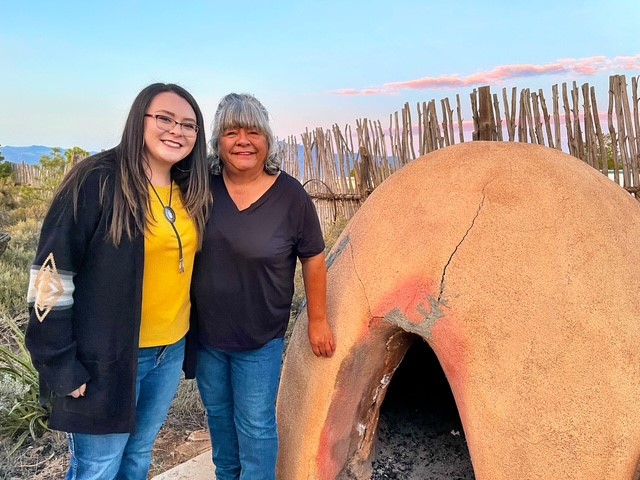
It stands adjacent to the house, atop a concrete slab; on a corner of the slab foundation sketched in for memory to keep are the date and initials: 6-7-05 OR
But what the initials and date on the concrete slab cannot fully capture is all the use the Romo’s family horno has seen over the years – entire pigs, lambs, or turkey cooked within its adobe cavern, enough to feed a family through the seasons, or an entire community gathering for a matanza. And the countless pounds of corn dried within the horno since its construction, home-grown sweet corn soaked, steamed, then dried. “My absolute favorite way to enjoy them is how my mom would prepare them, just cubed pork chunks with chicos, onion, and garlic simmered all day in a caldito (stew)…and then with some fresh tortillas, oh so delicious.”
*
Olivia’s familia built an horno. Imagine then, this functional tool, crafted and maintained by hand, then used to bake and prepare food to nourish a family, even community; such then is both the function and reflection of the horno itself, an essence as much about function as it is about architecture as it is about culture as it is about landscape.
The use of a traditional horno includes first building a fire inside the cavern of the horno, often using local pinion, cedar, or juniper wood, allowing it to burn for several hours; once hot enough, the fire and ash are replaced by the food to be cooked inside, and the entrance of the horno is covered with a homemade door and sealed with wet burlap sacks.
Imagine then, the colors of food from an horno – golden brown, crisp white, autumn orange, warm yellow. And speak the names of the foods that feed us – carnitas y maiz, pastelitos y pan.
But what feeds us as much as food, what nourishes as much as any protein or vegetable or carb, is familia, friendship, community.
*
Before leaving Llano Quemado, I ask to capture a photo of mother and daughter beside their horno.
I imagine all the food they’ve prepared inside. On the exterior, plaster cracks are showing, maybe from sun, maybe from use, but I also notice where the cracks have been mended, tended too, and inside the horno, ceniza (ash) still inside from the last time it was used.
What I really want to tell you is not just about the Romo’s family horno, but about the spirit of communidad and familia, the graciousness of daily human actions so often caught up in the fleeting song of what may seem ordinary. But Mr. and Mrs. Romo are far but ordinary. Mr. and Mrs. Romo raised a daughter, built an horno, color the world with the continuation of Taoseño tradicíones including food, language, and agriculture.
It’s the color of culture and traditions giving life to the harvest.
It’s as much the color of papitas and peas, lechuga, turnips, and beets. Hues from these vegetables and food have graced Mr. and Mrs. Romo’s garden throughout the season, and perhaps just as precious as the corn – blue and white – is the labor they put in, the traditions of the horno they pass down.
As I take the photo, Oliva and her mother lean in, one arm around the other one, like an instinct, and they both smile, sonrisas brighter than the yellow shirt beneath Oliva’s sweater.
And beside them, the horno stands, stout, low, and wide, hunkered into the earth, the color of its essence enough to feed both body and soul.