

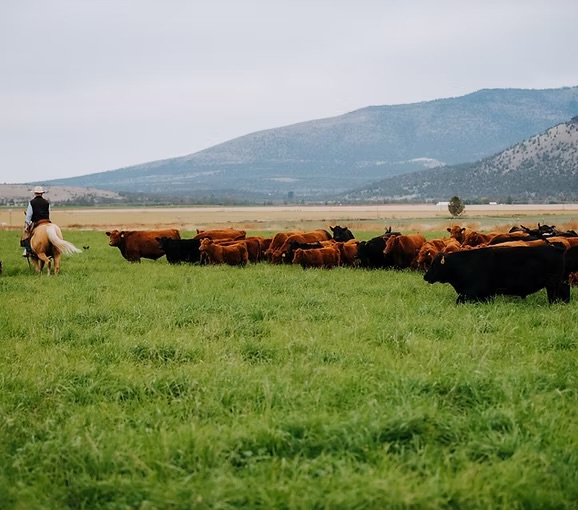
Growing into Myself
By Dan Flitner
Originally published in Resilience, Issue #46 – Colors of Home

When I was asked to write an article to bring awareness to mental health and what it means to me, to be completely honest, I nearly said no. I am not an author, writer, and can’t even boast that I was a good English student. Ever. After thinking about it and realizing the discomfort I was feeling, I thought I should challenge myself and take it on. Here is my attempt to share my relationship with mental health and agriculture, how it’s come into my life, and how I continue to grow spiritually and mentally into my truest self and my God-given talents and gifts.
Mental health was never on my horizon until I found myself with two beautiful kids suffering from depression, my wife struggling with them, and the two of us meeting with attorneys to discuss how to amicably divorce. I was in therapy by that time, per my wife’s strong and compelling request that “I see a f**ing counselor.” I was totally struggling mentally but had no idea with what or why. My wife’s background of trauma was more than willing to take the fall for all of our problems, and I was willing to let it. I did not realize how unhealthy and unstable I was at the time. I didn’t know what anxiety was, but looking back, I was jumping out of my skin with anxiety. I couldn’t understand why we were in so much trouble collectively. Our cattle and horse programs were finally ours and ours only. No more family to answer to, just my wife, Mary, myself, and the kids. It has taken years to unpack that and fully accept my role and responsibility. I think what I’ve come to believe as I wrestle with mental health is how important it is to rediscover ourselves going through our life story and looking at it through a new lens.
***
I began to question some things for myself and my system when I was 26 years old, the youngest son ranching with my folks and brother on our family ranch in Wyoming; I’m fourth generation on that ground. My brother, Tim, had been diagnosed with a slow-growing lymphatic cancer with not great odds. It was a shock to all of us, and we agreed to do whatever it took to get through this as a family. At the time, there was no clear path and the doctors were extremely conservative about Tim’s chances of growing old; although they could help, they told us that he should plan on a rough battle. We were worried about my brother and we were also worried about our ranch and how we could keep it together during this very hard time ahead. We knew it was going to be a rough go, but I was young and had always felt overlooked by my brother and my folks, and wanted to prove myself to them that I could take care of the ranch. I didn’t want to hire help because there was no time to train someone – I thought our exceptional hired hand, Luis, and I could take care of most of the work. I was putting in extremely long days and then coming home to my brother, who may or may not have eaten since I’d last seen him, and so I’d throw something together, clean up a bit, and get some rest. It was like that most of the summer. My folks were struggling with what was happening and why it was happening to us, as my family had been, for the most part, unscathed of emotional pain. My dad’s hardest times were always related to what was going on with the ranch and its finances, which were extremely difficult but nothing compared to the possibility of losing a family member. If I asked him about hard times, it would not be about my brother’s cancer, the illness that I contracted that year, or my eldest sister’s miscarriage that same year; it would be about the 1980s and how we barely survived and the ranch divorce he and his brother were still battling 20 years later.
Toward the end of the summer, I found myself unable to rest and extremely tired all at the same time – I just wrote it off to hard work and stress. I finally made a doctor’s appointment and after some blood tests, I was diagnosed with Graves Disease, which is an autoimmune disorder that affects thyroid function. I decided to take care of this as best I could without much support from family, so I went to my appointments alone and wouldn’t let anyone support me. I’d mismanaged my treatment plan and ended up at the ICU with heart palpitations for a few days. My doctor assured me it was going to be okay, but I was in for a long ride until things stabilized. Finally, ten weeks later, on the morning we were shipping our calves, my heart came to rest at a normal rate. It was an amazing sensation to wake up to a normal heart rate and I was so grateful. I wasn’t much help that day, as I didn’t want to risk upsetting my heart in any way, and my dad and I got into a fight about how slow I was moving. I was shocked. He was more concerned about the loading of the truck than he was about my condition. I confronted him with this and while he did listen, his answer was if I couldn’t be full speed to not show up. I tell this story not to belittle or begrudge my father, who I have a deep love and respect for. It is illustrative of the environment I grew up in. The ranch came first and everything else fell into line after that. That is how my parents survived – they sacrificed everything for the ranch to keep it together for the next generation. So we didn’t complain much and we learned to take care of ourselves and not to depend on a lot of help. We lived by the code that there was nothing more important than the ranch and we applied ourselves accordingly. It seemed like sickness and strife weren’t going to shake that way of living, and I was angry that we were going to fall back into the same patterns.
***
I met Mary at the beginning of my illness and we were married the following summer. We only spent a few weekends together before I’d asked her to marry me and not a whole lot more time together leading up to our wedding. Mary is a veterinarian and had taken an internship in Phoenix, and I had decided to go with her for the year so we could begin our life together. It was a hard decision to leave the ranch, and I felt guilty, as if I’d let everyone down. I also knew that I’d met the love of my life and we wanted to be together. I went to work framing houses while Mary worked around the clock as an intern for a clinic. I thought my job was to provide for her, so I never missed work; Mary had a similar belief system that work is where we found our value. But after two bad events in Phoenix (Mary getting a severe concussion while euthanizing a horse and then she was assaulted while on a call in the middle of the night), we decided to move back to Wyoming.
We spent the next seven years in Shell and I worked on the ranch almost every single day as she worked as a local veterinarian. We adopted our son, Samuel, in 2001 while we were in the process of building Mary a vet clinic. This is the period of time when I began to struggle with my mental health. I didn’t know it at the time but as I processed all of this later, I realized that I had gotten to a limit emotionally and I was depressed. I wasn’t looking-down-a-gun-barrel depressed but I was definitely not happy. My brother and I were working incredibly hard, my wife was working incredibly hard, we had just started a family, and Mary and I needed to support each other with our new infant son. I felt torn between being a dad and a husband while at the same time, felt like I was failing at the ranch and letting everyone down, including myself. I was checked out from my work and it was killing me emotionally. The only thing I’d ever felt good at was working on that ranch, and I started to hate going there. My dad was clueless once again; he showed up at my house the day we brought our son home and told me to get back to work. I didn’t go and he was furious. I had wanted to build an empire with my brother right there in the Shell Valley, and instead, I was exhausted and questioning my identity. I had worked so hard to prove myself through all of our struggles, and I had ended up very sick in the process. Mary and I had been going to counseling and I felt that I was faced with two choices: stay and support the ranch or leave and support my family. I chose my family.
***
We left and moved to Las Vegas, New Mexico to work for Mary’s stepfather, who had recently purchased a small ranch. Mary left a flourishing business behind and we both left a community that we feel, to this day, compares to no other. We spent the first couple of years just trying to get the house livable and getting a few improvements operational. We bought a handful of cows from George Whitten and his wife, Julie. We worked extremely hard, once again, to prove ourselves as valuable neighbors and bonafide ranchers. Mary took a part time job for an equine vet and I bared down, once again, on the ranch. We adopted our baby girl, Grace, who is from Guatemala, and was 16 months old when we got her. She’d been given to foster care at eight months old and now, eight months later, was part of our family, not knowing a word of English.
After eight years in New Mexico, we found ourselves once again in a family dynamic that wasn’t sustainable. Mary and I were struggling to please her folks. We felt we were being questioned as parents and I felt questioned as an employee. I had done an amazing job helping build a grass-finished beef program, Sweetgrass Coop, from the ground up and to this day, it is one of my greatest accomplishments. I had done countless improvements for livestock and wildlife on that ground to create a better environment for all living things. My in-laws didn’t value the work I’d done to help create such an amazing company and that just felt empty to me. We have all moved beyond these painful times but only by ignoring them, not by actually addressing how each of us was feeling.
There is deep pain and trauma in Mary’s family, and it has taken me years to try to understand and accept how people who love each other can do horrific things and carry on as if it never occurred. Mary’s childhood is laced with abuse and trauma rooted in alcoholism and violence. I thought that keeping these secrets over the years was in protection of Mary, but ultimately it only protected the perpetrators: the alcoholic father and stepfather who have too much shame to truly do the work to heal themselves, and a mother with an even deeper shame as both a victim and as an abuser herself. So what I’ve witnessed is an embedded system filled with dark emotional and physical abuse that is completely off-limits because of the unprocessed pain. Mary was the victim and receiver of the burdens of abuse; to this day, none of her caregivers or perpetrators have ever taken any responsibility for the acts they committed. When we got married, Mary was forthcoming about her family’s past but neither of us truly knew the impact each of our pasts were going to have on our marriage and family. I’ve come to understand that we each have trauma and pain but deep trauma is different; it is most often passed down from generation to generation and embeds itself in the family system. The lies and shame are embodied by the actors and victims, so it continues on unless someone finally breaks the cycle. I was not equipped emotionally at the time to understand or deal with this system. Unhealed abusers bully and control the narrative with whatever power they have. My in-laws could be so incredibly generous one day and then the next take it all away so we were in a cycle of finally getting approval and then it’s gone in a moment. We adapted every way we could to be accepted and it was never good enough
We had grown to love that community in Las Vegas, our kids were flourishing, and we had earned the respect of both the ranching and larger community. But we couldn’t stay. I once again found myself leaving a piece of land that I had deeply connected with. Mary’s mom needed to get to a lower elevation, so they moved to southern Oregon and we wanted to be close enough to them to support each other so we moved from New Mexico and purchased the place in Oregon we are still at today.
***
We were so excited to be on our own in Oregon, and we felt good about the community here for our kids who were in the fourth and fifth grades at the time. Mary and I went to work like crazy to make our dream come true. The place we bought was in really poor shape – the fences were all falling down and the irrigation systems were in terrible shape – and so it was basically one emergency after another of either cattle out or something broken. I applied what I was taught. I had to work hard to prove myself to our neighbors and also to my past self in Wyoming and New Mexico, where I had felt like such a failure. This is when the real mental health struggles started to show up in my life. Gracie and Sam were having a real rough time adapting, so we started seeing a family counselor. It seemed to help, but it didn’t take away from the fact that they were really unhappy at home. I took the optimistic approach, which was to dismiss it and tell everyone that it was going to work out; we were great parents and these were great kids, so of course it was going to be fine. Things weren’t fine and both of our kids went through some really rough spots with depression and it was taking its toll on all of us. I began to check-out emotionally. I was physically present and trying to show up for our kids but I was coping by working harder and letting every ranch problem be an emergency that I had to deal with. I wasn’t even aware I was doing it. I maintained this optimistic attitude with Mary that was completely unrealistic and dishonest. She knew and could feel we were all falling apart and was asking for more of me, so I worked harder because I thought that was what more meant.
I completely lost myself in this period. I was a cowboy with lots of experience and a strong work ethic; I was raised to think that was all that mattered and that that was what fixed everything. I was crawling out of my skin because everywhere I looked, I was failing. My kids were really suffering and I had never witnessed or carried the kind of pain they were in. The ranch was not doing well at all, as we had purchased a place that was in way worse shape than we thought and also way harder to physically work. Financially it wasn’t making sense. Mary and I had come to an impasse in our marriage and we were talking about divorce, or at least separation. I was anxious and unpredictable and dishonest. I’d say I would be somewhere or do something and then not show up. I had a ranch emergency, which always trumped any other problem someone might be having.
I was hiding in this pattern and it was killing me. I was so angry at everyone. I was having to do all of this work and nobody even cared. I was mad at Mary because she could not see how hard I was trying or working. I was mad at the kids because they were struggling. I was at nearly rock bottom; I’d lost 25 pounds and was back to my high school wrestling weight. I honestly thought I was fine and was just waiting for everyone else to get things figured out so we could get on with our lives. Mary demanded I see a counselor, which made me even more mad because at this point, I thought our marital problems all stemmed from her childhood trauma.
I did find a really good counselor and he helped me start the process of healing from all of the wounds that I didn’t even know I had. It was slow because I really didn’t think I had any wounds. I thought all of my problems stemmed from everybody else’s wounds. Mary and I met with a divorce attorney not long after I started in counseling, and I remember going straight from my counseling appointment to the attorney’s office to see how our divorce was going to look. I was shattered. I felt so misunderstood by Mary and I still could not see my way through a divorce. It was excruciating and I was an emotional mess. We both were. When you are in emotional pain and angry, you are not exactly in a balanced headspace to do combat. You say and do things that hurt and you are being hurt the same way. It’s a vicious cycle and I truly don’t know how we survived it. For me, it started when I finally started taking responsibility for myself.
***
Over many counseling sessions, I finally discovered that even though I thought my childhood had been wonderful, the ways that my family members interacted with each other created in me a belief system that told me that I am inadequate. It wasn’t mom and dad’s fault; it was just what happened to me growing up. I wasn’t taught how to feel or listen to emotions as a child. We threw some dirt on it and got to the task. I am grateful for that hardness and I am sad that I didn’t learn how to cope with things well. I love the cowboy toughness mentality and how it taught me to see things through, but I just wish I would have been taught another side, a side that would have said, “Hey little man, I know this is really hard and we are asking a lot but you are amazing and we will get through this together. It’s okay if you need to cry and I can tell you’re mad, why don’t we talk about it for five minutes.” We simply weren’t given the time and I don’t think most kids from my generation were. It left me in a bad spot later, when my kids and wife were really needing me to see how much pain they were in and I couldn’t because in reality, I was feeling pain, too. I ignored it and distracted myself with work until it nearly cost my everything. In the mental health profession, therapists talk about emotional awareness all of the time and I can honestly say it’s taken me years of hard work to fully understand the concept, but it has been a huge part in my coming back to myself.
I began to see that I was not being honest with myself and that I needed to learn how to build value from inside of myself instead of thinking it comes from performing tasks and working. Unpacking a belief system of inadequacy that I developed and reinforced for over 45 years has been really hard. I prayed to God and read the Bible, I meditated and went to yoga, and I went to a lot of therapy. I read self-help and marriage books, and Mary and I went to retreats, hungry to heal. When I found myself in an attorney’s office talking about a divorce that nobody wanted, I knew I had some choices to make. I could get a divorce and start all over, alone, and continue to work; I knew this would have given some short term relief. Or I could get some help and try to grow emotionally and spiritually into a person who has a better understanding of himself and therefore sees others more clearly. I am so grateful that I made the choice to grow and see myself more clearly. I now can discern that when someone is in pain, it’s not my pain. I can’t fix it but I can be present with them. I know if I am in pain that I can be honest with myself and my loved ones and it doesn’t mean that I’m weak. It actually means I’m honest and courageous. I still find myself in old habits from time to time and only now I recover quicker and accept that I am still a work in progress.
Help/resources language
The 988 Suicide & Crisis Lifeline is for everyone. Through the 988 Lifeline, you have access to free, quality, one-on-one assistance. Whether you’re facing mental health struggles, emotional distress, alcohol or drug use concerns, or just need someone to talk to, caring counselors are here for you.
The AgriStress Helpline® is a free and confidential crisis and support line that you can call or text 24/7. The helpline is answered by trained professionals who can offer support and help you find mental health and agriculture-related resources in your area. If you or someone you know is struggling, call or text 833-897-2474.