

From Plates to Pastures
Sarah Knight
Originally published in Resilience, Issue #45 – Searching for Home Ground
 As I walked the buffet lines before the doors open to welcome the newlyweds and their loved ones, I checked the presentation of the food and added final touches. I wiped smudges or added garnish, while the front of house crew did the same for the equipment, silver, plates, and lighting. They checked the orientation of the displayed hors d’oeuvres and wiped up the moisture pooling at the bottom of the lid when chafing dishes were opened. I’d made note of areas to improve upon next time, remembering how something was executed in the kitchen and the effect it had on the food in front of me now; why spend so much time searing rockfish for a perfectly crispy skin only to have it soften in a humidity-filled chafing dish moments before being served?
The attention to detail for this event was different. Not merely in size — 250 guests — but this was the wedding of the property owner’s daughter. The owner and his family, a whole horde of restaurateurs, picked our location to hold this once-in-a-lifetime event. The welcome reception offered top shelf liquor and wine, eight passed appetizers, an oyster shucking station, and a build your own ceviche station to start. The ceremony followed, giving the kitchen 45 minutes to finish executing the food for the cocktail hour. More food, more drinks. We had six different food stations to replicate iconic scenery and menu items found at each of the family’s restaurants. Build-your-own sushi rolls, fire-grilled teppanyaki. More oysters and crudo. A whole snapper carving station. Mounds and mounds of olives and feta threatened to topple onto guests’ open-toed shoes.
As I finished checking my list, I stopped to stare at a wall of seafood resting above heaps of ice. Red snapper and crustaceans adorned with seaweed, edible flowers, shells galore. This display cost $2,244, and wasn’t intended to feed anyone. Twelve whole red snappers sat there, their presumed destiny no more than props. I was the product of the corporate chef world, trained by skilled chefs, some of them even Michelin-starred, but eventually molded by managers and owners seeking profit; meeting quarterly goals had become the norm, not the creation of delicious food. Because of that, I had hoped for a meaning or purpose greater than family, or staff, meal for this snapper, hoping to make a profit somehow, to combat the food cost of this event. While the newlyweds and guests had the time of their lives, while the sales team raked in bonuses and gratuities for the price tag of the event, and the teams across the company worked for hours to finish this successfully, the cost of it all was starting to weigh on me. The requirement to please the client willing to pay, at the cost of land, animals, and people, made me feel desolate.
For large events, we frequently ordered pre-fabricated meat to save on labor. More often than not rockfish filets would come in hacked to pieces by the cut floor of their facilities. The system is set up so we can send the product back if it isn’t sufficient. I asked the driver once what happens to the fish upon its return; he said it’s either trashed or sold to a pet food company. The wedding sales team often sold plated events because of its higher revenue potential, and well, a beautiful plated dinner is simply that…beautiful. So we would plate rockfish and filet mignon with out-of-season asparagus. And then, for some reason, when asparagus was in season, the sales team would start selling mini rainbow carrots. For a wedding of 125 guests, which was common, we would order enough protein for 140 people, to cover mistakes or overcooks. A steer has two tenderloins, each of which provides about ten filets. In order to cover our numbers, we would need the tenderloins from 27.5 animals. It’s harrowing to think about. Where did the other 27,000 pounds of meat go?
I couldn’t stop thinking about how unsustainable it all was. Something had changed in me. The unused snapper filets, cleaned and sitting frozen for weeks on end, were haunting me. The off-season asparagus from Mexico started to wear on me, having to send back pencil-thin stalks for fat stalks because they weren’t good enough for the guests’ plate.
While I watched food get thrown in the trash daily, as I inspected vegetables from Mexico and California in our east coast mid-Atlantic kitchen, I questioned everything I was doing. Beholden to a company-approved wholesaler supplier list, and tired of half-truths on menus, I really started to feel the weight of being a part of the problem. Food was a commodity, a resource used to make profits for the company. The people creating the food are not paid well enough to live a sustainable life. Examples of waste were everywhere. Water would run for hours to defrost food frozen from across the world. We didn’t recycle, we didn’t compost, and conservation was not a thought. I loved the people, I loved Baltimore, living in the city, and loved the food, but realized I was doing myself, the industry, and product a disservice. So, I quit. I wanted to understand our food system and what it means to grow and raise food well.
••••
 Six months after that lavish wedding, I sat at a long wooden table in a barn listening to my farm manager lay out the day’s goals. One by one, the farm manager, livestock manager, mechanic, and groundskeeper each discussed the equipment needed, how the cover crops were doing, the lay rate of the hens, and which steers to send to the slaughterhouse. A calico cat sauntered around the table randomly picking (or so it seemed) which person she wanted to flop in front of for pets, only to claw at them the moment it was too much.
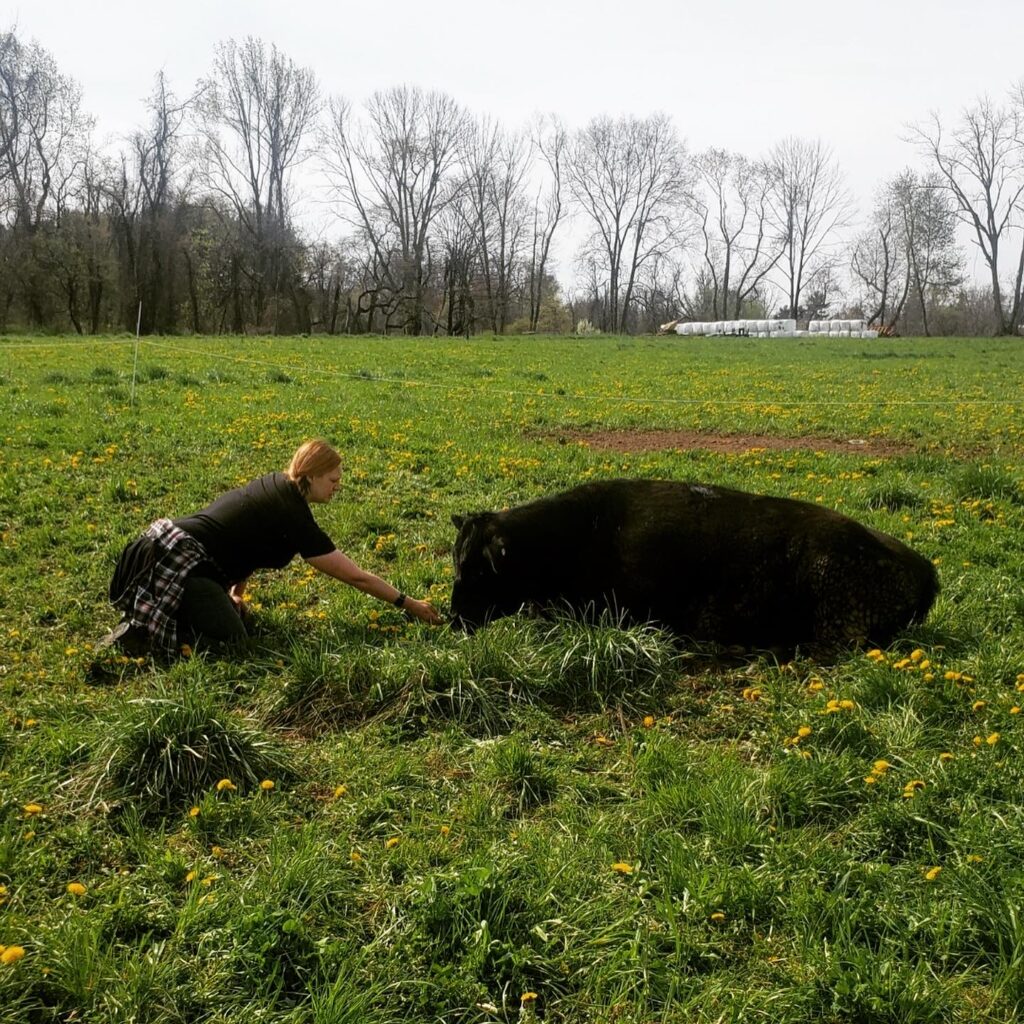
With the meeting over, it was time for daily chores. In my new role as livestock apprentice at Carversville Farm Foundation, my first task was to collect the eggs, which I picked up off the high-tech mechanical belt quite slowly, terrified of breaking one. I was still figuring out how to change my natural grip that was used to picking up steaks out of a pan to slice to handling moments-old eggs. After the collection, the livestock crew headed to the winter cattle pasture. Though there was no more snow for the season, it was muddy, wet, and cold. The cattle didn’t seem to mind. They lounged on dirty straw, chewing their cud, observing us. While we stood there, our manager explained pasture-based cattle operations, and I tried to keep up with what I was learning from him while simultaneously learning from the gorgeous beasts I watched. The group of 14-month-old steers, one by one, rocked their weight onto their hooves, stood up slowly, and walked over, all the while sticking their tongues into their nostrils. They came toward us, curious but timid. I got to rub the crown of steer #811, and because I was the only one granted the privilege, I had no doubt I was going to be a natural.
Leaving a professional position as an executive sous chef — a position I had worked long to achieve — to become a livestock apprentice was gutsy. I was 36, working and living with people who ranged from 19 to 28 in age. They all had more experience in farming than I had, and used a language with which I was unfamiliar. They asked me cooking questions and I asked farming questions. Once, I asked my manager how soil regeneration works. I pointed to the cattle pasture, then down the hill to a vegetable field, asking if those soils were benefitting from the cattle pasture a half mile away. “It doesn’t work that way,” he politely said. But he did reassure me that just because the fertilizer naturally found in cow manure wasn’t benefitting the soil in the vegetable field, it was most certainly helping to build resilient ecosystems by developing biomass, and organic matter in this pasture. I nodded, then proceeded to look up the definitions of those terms.
In cooking and restaurants, the variables are all familiar things I knew how to prepare for: adjusted guest count, broken oven, allergies, delayed deliveries. My instincts were honed on issues and decision-making in high volume, high stress kitchens. When it came to farming, to animals, to the outdoors, my instincts were garbage. I fell, didn’t read the steer’s body language properly, became scared and unsure of myself. I clumsily made knots of full spools of fencing wire daily, and I stalled tractors. I would tend to my bruised ego by occasionally treating myself to a steak from the farm, only to set off the smoke alarm. My body hurt, my brain was on fire, and I was deeply tired. I stumbled, asked stupid questions, and got kicked off jobs. I was asleep by 8 p.m. nightly, and then up with the sun. I loved it all.
Eventually I found my footing and even started performing with some competence. I continued to learn. I had the privilege of working at a farm that practiced regenerative agriculture, was certified organic, and had on-site slaughter. It was through the daily diligence of these methods that I learned what it means to raise animals well, to grow vegetables, manage pastures, tend to ecosystems, and regenerate soil. For all of these skills learned, I also realized there is never one answer, and whatever the answer or solution you choose, it’s only a small part of a much larger equation. Farm life and learning are the same: they never end.
••••
My nine-month livestock apprenticeship lasted two years. Working in agriculture was the best treatment for my depression. I used to spend 12 hours a day in a windowless kitchen, just trying to drink enough water. Eating the food I raised on the land that fed it is the ultimate version of reciprocity. Being at the slaughter house with the first steers I helped raise from their first day on the farm until their last. Assisting in their final moments, watching the fibers in their muscles twitch as they were inspected. Seeing the pasture, still fermenting in their stomachs. Feeling their warm bones and flesh in my hands. And finally, three weeks later, being able to bring them back home, and slap one of the most well-marbled steaks over a hot charcoal fire, while watching the sun set over the same pasture of clover that created this marbling. That was one of the most rewarding, if not the most rewarding experiences I’ve ever had. The result of the hard work — from seed and young steer to permanent pasture, food, and improved ecosystems — beat the faux, exhaustion-filled satisfaction from some drunken, shit-eating grin of a rich guy eating a sourceless filet mignon from a feedlot. Until this time, these moments, I don’t know that I could have told you why I had been depressed. But it became obvious that not only had I been lacking the basics that make a good quality of life — daily sunshine, connection with nature, a purpose greater than capitalism — but now, I got the best quality of everything.
Seeing an animal grow from its first day to its last has helped me realize how important small, regional food systems are, the importance and value of humane animal handling, and of seasonal eating. Seeing the sun change paths over the course of a year on the same land helped me recognize that every season is a new season. I noticed the difference between a sticky morning dew as it touched my skin and a soft evening mist when putting the hens to bed, their coos a lullaby. What it means to assist in the development of life, only then to take it a few months later; to love, to kill, to consume, then ultimately give it back to the place from which it came. In my final summer there, I was getting ready to collect eggs when I realized the pasture we had just moved our hens into was neighboring the asparagus patch. It was the end of the season for the asparagus and it was no longer being harvested. So I walked, pinching and breaking off the tips of asparagus stalks between my fingers and crunching down on them while watching the hens forage, realizing that this was what I had been looking for (in addition to knowledge) — a sense of being where I was supposed to be.
Since that apprenticeship ended, I’ve ranched cattle in Montana, I’ve farmed on cow-calf and pastured pig operations. I’ve worked in slaughter facilities, and I’ve learned whole animal butchery. I’ve eaten meat from a 16-year-old grassfed cow, and it was better than any 18-month-old steer I’ve ever had. I can tell you about how an animal was raised just by looking at its hanging carcass. Identifying grasses, the body condition of animals, the annual rainfall…these are the things I think about now.
These days, I find myself in a multi-faceted role of chef, farmer, butcher, and educator at a not-for-profit higher education institution located in the high desert area of the eastern Sierra Nevada mountains. I cook the food we grow here, slaughter the animals we raise, and teach students how to do the same. Working towards a completely closed-loop food system is the goal; this year we’re focused on upgrading our compost program, increasing our reliance on our ranch and farm produced product, and trying to eradicate our land from invasive Russian Thistle so that our cattle’s natural forage diversity can increase. I still find myself wanting to cook what I used to, to challenge myself to make the best tasting and best looking plates of food. Wanting to earn the same accolades as my industry friends who are still absolutely crushing it on the line in their restaurants every night. However, the desire to return to what I did before, in the same capacity, has changed. It sounds trite, but restaurants and hotels aren’t good enough anymore. The walls and restrictions of those institutions have forever been torn down for me. I no longer am required to use food as decoration, to waste lives, or work in extractive systems. I get to work in systems that mimic the natural systems as old as time. Growing food, raising animals, slaughtering on-site and cooking in our kitchen for our community. While I still occasionally play around with the idea of growing microgreens for the sole purpose of garnishing plates, I get to stop and recognize that the desire to create beautiful things will always be present, but it doesn’t have to be on a plate. Beauty is created around me by the land and animals. All I have to do is not get in the way.