

A Farm Bill For the Next Generation of Working Farmers
Erin Foster West and Adolfo Alzuphar
Photos by Tom Daly
Originally published in Resilience, Issue #45 – Searching for Home Ground
As an organization with a mission to resource young farmers by shifting power and changing policy, National Young Farmers Coalition (Young Farmers) is discussing the 2024 Farm Bill with farmers all over the country. Through text messages or phone calls, at conferences or by hosting events, we pride ourselves in our ability to connect through honest and empathetic communication that embraces the role that the government plays in farming and ranching.
In Colorado, and throughout the West, where Young Farmers has a very exciting presence, conversations about equity and diversity abound. Young Farmers chapters in Colorado are dynamic and inspiring, and the Flatirons chapter’s Hoe Down — an annual celebration in community, dancing, and good food — is not to be missed. Young Farmers organizers are in constant communication with Hunger Free Colorado and other organizations that seek to connect Coloradans to food resources, all the while working with groups such as Women in Ranching, who champion rural women’s leadership.
In Pennsylvania, Young Farmers organizers work both with Pittsburgh-based organizations and coalitions and rural organizations, with the aim of bridging the two. In House Committee on Agriculture Chairman Glenn Thompson’s district, Young Farmers visit farmers who, like in Colorado, believe that the policies that we advocate for should support families and communities; our policies should address the historic disenfranchisement of people and communities, including Black, Indigenous, and people of color (BIPOC) and rural communities. By bringing together urban and rural communities, Young Farmers builds common ground.
In the Northeast, where Young Farmers was founded and community is central to our work, the message is simple: we need policies that tangibly support this generation of young farmers and bridge optimism with real resources. Some of our chapter work even includes grant-making to farmers.
Throughout the Midwest, young farmers in chapters and those working with our organizers do not shy away from a holistic future for agriculture, whatever the challenges may be. In Michigan, we met farmers at a Farmer Wellness series that we co-hosted, and supported farmer leaders through constant conversation with young farmers about the disenfranchisement of people and communities, and how we can create the world we want to see. Supporting queer farmers in Detroit is central to our work, which Young Farmers does by networking with queer farmers in order to address isolation, and collaborating with the Queer Farmer Network.
In Iowa, Young Farmers collaborates with a wide range of groups, from environmental groups to young graziers to food banks. This allows us to not lose touch with one of the most important states for agriculture in this country. In the Southeast, supporting the leadership of BIPOC farmers practicing sustainable and organic farming allows us to truly feel the audacity and the power of young farmers. There, optimism takes root alongside okra, and despite setbacks, Young Farmers does not shy away from conversations about equity and diversity.
***
 In Young Farmers chapters across the country and through the efforts of our field organizers, we learn to speak to each other and work together. Farmers, as our national survey has shown, are an intellectual bunch. There is absolutely no way that a Young Farmers organizer can get away with a one-sided conversation, which explains both excitement and vulnerability that goes into being an organizer. Whenever a farmer takes time out of their schedule, especially during the harvest season, they are stepping onto a front porch with us, and we pull out our best chair for them.
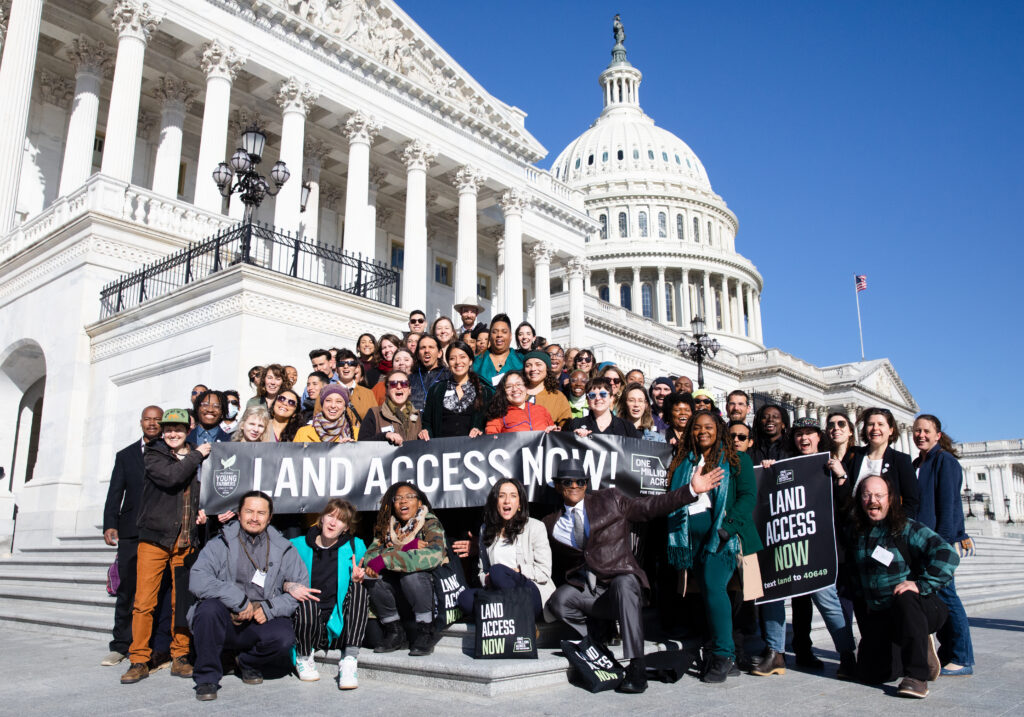
It would not be forthright to pretend that meetings on the farm bill jump directly into the latest statistics. Discussing life, love, a picture of a newly-born calf, are integral to thinking and acting in common. When it comes to the farm bill, in our engagements, young farmers and ranchers across the country — from Michigan, Georgia, New Mexico, Louisiana, Colorado and beyond — are hugely concerned with land access. Which means we are also concerned about it. It’s not news to anyone that land is not easily accessible for young farmers and ranchers. What’s unique about our network of farmers is that many have a land story, many of which include having lost a farm, and they want new policies.
Every five years, the farm bill directs billions of dollars to food and agriculture programs. These funds are not meeting these young farmers’ challenges. They don’t support these producers who are working to address the climate crisis, feed their local communities, or even purchase their own land. Congress is currently writing the next farm bill in Washington, D.C. This is a major opportunity to directly support this next generation of working farmers.
Young Farmers has been working closely with Congress to support three key pieces of legislation that would address the challenges of access to land and capital, and help them adapt to the changing climate: Land Access, Securities, and Opportunities Act; the Farmer to Farmer Education Act; and the Small Farm Conservation Act.
At a recent rally we hosted, one of our land access fellows shared with us that they had recently lost their farm, due to not being able to access capital. It was a sad moment, one that we hear much more often than when, for example, a staff member announced that they had finally purchased land for an apple farm. Both stories are evocative of the trials and tribulations of young farmers today. In both instances, young farmers deserve our solidarity and support in order to succeed.
In fact, land access is the number one challenge that farmers and ranchers face across the country. A farmer’s ability to access land extends far beyond just their fields. Unstable land access can affect their access to markets and capital. Secure land tenure, such as ownership or a long-term lease, is essential to providing farmers with the certainty they need to invest in and grow their operations.
Congress has an opportunity to support BIPOC farmers by including the Increasing Land Access, Security, and Opportunities Act (LASO) (H.R.3955, S.2340) in the farm bill. LASO would provide funding for equitable land access, transition, and retention through projects led by community-based organizations. These projects would help producers start and grow resilient farm businesses.
Strong pathways to land access for new farmers not only keeps land within agricultural communities, but also retains land and knowledge within these groups. Farming communities are already responding to the issue of land insecurity through community-led land access efforts, but policy change is necessary for long-term and lasting change.
Land access isn’t the only need that must be addressed in the farm bill. Most farmers and ranchers, especially those newer to farming, are operating on paper-thin margins. Climate change further threatens their farm viability as farming becomes less and less predictable. Policies like the Small Farm Conservation Act (S.2180, H.R.5354) and the Farmer-to-Farmer Education Act (S.2614) would provide more funding and technical assistance for young farmers to adapt to and mitigate climate change. Conservation practices, like cover cropping, don’t just benefit farmers — they also benefit their communities and broader ecosystems. However, farmers face many barriers when it comes to using these conservation practices. These include lack of access to the right equipment and materials and insecure land tenure, to name a few. These bills would improve access to small farms to existing USDA conservation programs and invest in farmer-led education.
Young Farmers want the farm bill to help make agriculture a much more viable way of life. At a recent event we hosted in Kentucky, a farmer even proposed that with land access we could bring an end to hunger in communities across this country. Not only do young farmers want land to start small businesses, but also to contribute to how local democracies go about addressing community issues.