


Evolving Views of the Leopold Legacy
By Dr. Richard Rubin
Originally published in Resilience, Issue #46 – Colors of Home
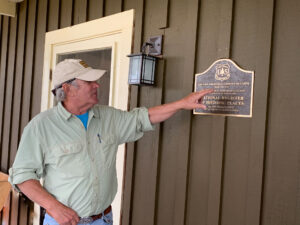
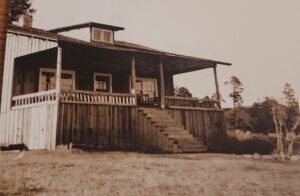
Quivira Coalition’s co-founder Courtney White has been immersed in Aldo Leopold’s conservation philosophy and science. He was the first Leopold Writing Program Resident at Mi Casita in 2012. This new program sponsored environmental writers with a month’s retreat at the 1912 vintage house Aldo built in Tres Piedras when appointed supervisor of the Carson National Forest. Aldo’s new wife, Maria Estella Luna Otero Bergere, happily named the Craftsman-style bungalow Mia Casita, now known more popularly as Mi Casita. They only enjoyed seven months there, as Aldo suffered extreme weather exposure in 1913 when managing grazing permit conflicts in the northern Carson. His kidney failure required sixteen month’s recuperation before returning to Forest Service office administration work in Albuquerque. Aldo went on to initiate important advancements in wildlife preservation, overgrazing and erosion management, and wilderness area protection. To summarize a rich biography, he and Estella then moved to Madison Wisconsin where he pioneered university ecology teaching and the restoration of depleted farmland. Their “shack” land in Northern New Mexico is now preserved by the Aldo Leopold Foundation, which was created by his wife and five children after he died while fighting a neighbor’s prairie fire in 1948.
Courtney’s advocacy of Leopoldian knowledge infused the early work of Quivira, but this commentary is not to review the organization’s past but explores the evolution of the Leopold legacy in New Mexico and the world today. I can speak to this from 10 years’ experience as volunteer steward of Mi Casita and student of her development from Forest Service utility to inspiration, scholarship, and education center. This paseando will provide substance for how the Leopold legacy still matters.
The Origins to Now
 It is fair to ask how this outdoorsman from Iowa who graduated from the Yale School of Forestry in 1908 and his subsequent work deserve our attention now beyond just interesting history. On first assignment in the Arizona Apache National Forest when large predator control was policy, Aldo’s survey crew shot a mother wolf and her cubs. Moved deeply by the experience, 25 years later, Aldo wrote an essay that has become foundational in ecological literature. Titled “Thinking Like a Mountain,” he described his epiphany “watching the fierce green fire fade from her eyes.” Scholars have identified over 300 essays, journal articles, lectures, and thousands of field note pages that are archived at the University of Wisconsin and curated by the Aldo Leopold Foundation. The collection of essays published posthumously in 1949 is titled “A Sand County Almanac and sketches here and there.” Thought centers around the world recently celebrated its 75th anniversary, including translation now into 14 languages. The anniversary edition has an introduction by Barbara Kingsolver that ends: “For the urban reader, I hope you will let down your guard with this man as he sits on his rock in the stream, waiting for his trout to rise. If you take him for a redneck, listen anyway, because he’s wiser than most any two of us put together. He may help you see past the frustrating divides that plague the awfullest failure of our day, as we try to reconcile human subsistence with the needs of our damaged biological home. If you’ve lost all hope of finding a common language for that conversation, you might find it here.” (Oxford University Press, 2020).
The Recent Literature Story
Keeping this essay’s view to the present, I know about such Aldo literature because Mi Casita was given the start of a library in 2012 by the Albuquerque Wildlife Federation: 16 books of scholarship by and about Aldo. In his Albuquerque Forest Service administrative years, Aldo began advocating for the habitat management and preservation of wildlife. He founded the New Mexico Game Protective Association in 1914, and this subsequently was renamed the Wildlife Federation. Still active, this volunteer group does field-based public land restoration and ecological regeneration projects. When beginning my volunteer service at Mi Casita in 2014, the collection was thrilling for this old doctor who might have become an ecology professor, having read the Almanac in college. Among my curiosity, the Wisconsin Leopold Foundation resources, publications by the writing program residents, regional Taos history and culture authors, Forest Service donors, current environmental commentaries, and even a retired agricultural economics professor’s collection; this library now has 145 volumes available to Forest Service staff, visiting students and scholars, and eventually, the public.
Historic Registration
Why does this old Forest Service utility building now accommodate such resources? After the Leopolds left in 1913, it housed many staff. The Civilian Conservation Corps converted it to a bunkhouse in the 1930s. Facilities and appliances were eventually modernized, original features remodeled, and the appearance painted with government institutional colors. The modern story begins with the conscientious work of Forest Service archaeologist, Jon Nathan Young, to complete the extensive application for National Historic Site registration, achieved in 1993. His application states: “The Old Tres Piedras Administrative Site stands as a constant reminder of the day when Aldo Leopold – founder of the American Wilderness Movement – administered the Carson National Forest from its headquarters at Tres Piedras. More importantly, the Site is a living memorial to the very beginnings of the National Forest Service and the American conservation ethic.”
Restoration
After achievement of this distinctive status for Mi Casita, the next significant evolution occurred with the celebration of the centennial of the U.S. Forest Service in 2005. Funding was authorized for restoration of the house to the original bungalow as designed by Aldo in 1911 and built in 1912. The house aesthetic had harmony with the setting, natural finish woodwork, and multiple windows open to the environment, in contrast with decorative Victorian architecture. The rigorous 2005 Aldo Leopold House Restoration and Rehabilitation Plan stated: “When restored and rehabilitated, the house will function as a retreat for persons interested in modern conservation issues and as an interpretive site…The Forest Service will offer the house to the public as a place of reflection and scholarly pursuits.” The extensive work was completed in 2007 by the HistoriCorps volunteer organization under the supervision of district ranger Ben Romero. Modern electric wiring, smoke alarms, a gas furnace, and plumbing were provided for public safety and accommodation as a temporary residence. The newer feature of additional bedrooms expanded during the Civilian Conservation Corps bunkhouse days was maintained. Of value for the aesthetic, the plan comments: “Leopold was obviously a man partial to the outdoors, so perhaps the desire for light and a view was a priority in the house design.” The front porch opens to a magnificent wide vista of the Sangre de Cristo mountains 30 miles across the Taos Valley.
However, the restoration plan introduced an administrative complication: “Continued maintenance of the Leopold House will not be possible without a cost recovery strategy. Adequate funds have not been, and will not be, available through appropriated (tax) dollars. This has been the trend for decades within all public agencies. It will be necessary to charge rent for the use of the Leopold House so that the Forest Service can recover operations and maintenance costs.” Given the extraordinary demands recently on Forest Service resources – such as wildfire management – our subsequent Mi Casita story has progressed to community volunteerism and philanthropy.
Modern Stewardship
Interested people began discussing how the new mission could be fulfilled. In 2011, Albuquerque architect with conservation interests, Anthony Anella; director Buddy Huffaker; biographer Curt Meine from the Wisconsin Leopold Foundation; Carson Forest leadership; the Tres Piedras ranger, and interested others developed the Leopold Writing Program. The Forest Service agreed to provide two month-long house stays as community outreach. Courtney was recruited to be the first writer resident at Mi Casita in 2012. My Leopoldian odyssey began in 2014 when collaborating with Forest Service staff to lead New Mexico Native Plant Society field trips. I was taken to Mi Casita, and was enchanted with the opportunity to immerse myself in ecology during retirement; I was then recruited for native plant restoration there. The experiences of living the tradition, appreciating the setting as Aldo did, learning from the new library, and being useful for the historic house maintenance, were very engaging. In 2018, the Carson Forest staff cited me as an outstanding volunteer. Soon after, the district ranger asked me to organize a Friends of Mi Casita volunteer group. Pursuing my intention to create a philanthropy, the Taos Community Foundation approved our group for nonprofit Community Impact Fund status. Various donations have allowed us to replace warped porch floors, improve interior safety carpentry, get ahead of the invasive rodents, install a chimney liner, and repaint the weather-beaten exterior. We also helped the Forest Service obtain a federal grant to replace the old cedar roof shingles with fire retardant upgrade. My availability on-site provided guidance for community, college student, and school kids group visits. And several volunteers enjoyed connecting through our annual oiling of the porch rails. The Friends of Mi Casita received a certificate of appreciation for our continued stewardship from the Carson National Forest in 2024. You can find more details in my book “Living the Leopolds’ Mi Casita Ecology,” (Nighthawk Press, 2022) which explores the old history and new developments from the past century to the present. All book sale proceeds are contributed to the Friends of Mi Casita Fund.
Our Ongoing Evolution
Aldo’s definitive biographer Curt Meine, professor at the University of Wisconsin, summarized: “Leopold may be regarded not as an apotheosis of conservation thinking, but as an essential transitional figure within a still broader, ongoing movement, informed by an ever-evolving ethic of care.” (“Land, ethics, justice, and Aldo Leopold,” in Socio-Ecological Practice Research, July 2022). Aldo stated it this way in the Almanac “Land Ethic” essay conclusion: “I have purposely presented the Land Ethic as a product of social evolution because nothing so important as an ethic is ever ‘written’…because evolution never stops.”