

Spring 2026 Red Canyon Gathering
RSVP for Event
Details
- May 15 - 17 2026
- Expired!
- 4:00 pm - 12:00 pm
- Red Canyon Reserve
- near Magdalena, NM
Download / Add Event to your Calendar
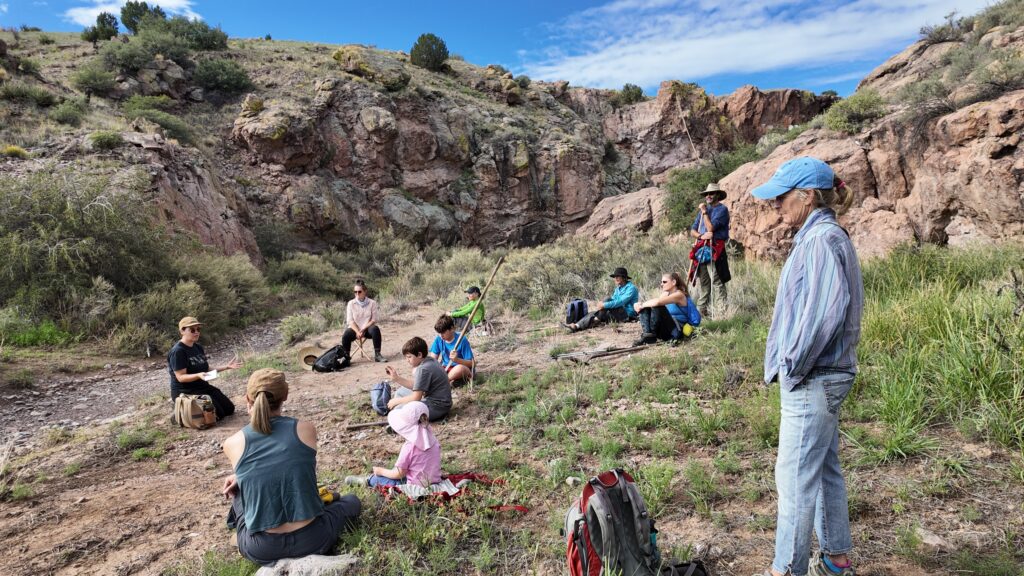
Be a part of a habitat restoration study at the Spring 2026 Red Canyon gathering! Join us for a weekend of camping, cactus adventures, and conservation volunteer work.
If you’ve been to Red Canyon Reserve, 320-acres in the eastern foothills of the San Mateo Mountains, you know it’s a special place for early morning canyon walks, meals around the fire, and deepening your connections with the great outdoors. Red Canyon Reserve is a living laboratory for community building and learning about rangeland health, Southwestern flora and fauna, and erosion prevention.
On Saturday morning, you’ll learn how to build Zeedyk rock structures, a low-cost, high-impact conservation practice that increases the hydraulic and ecological sustainability of a dryland area. You’ll be able to take that knowledge onto your own land while volunteering to keep Red Canyon Reserve a healthy habitat.
On Saturday afternoon, you’ll be a part of a Quivira Coalition habitat restoration study. Joining us from University of New Mexico and Quivira’s Dr. Eva Stricker, who will lead us in a soil amendment activity focused on enhancing grasslands and stream systems in southern New Mexico. This is a great chance to learn and ask questions about organic soil amendments like biochar and branch mulch.
On Sunday morning, Cari Powell, director of Friends of Bosque del Apache’s Desert Arboretum and member of the New Mexico Cactus and Succulent Society, will lead us on a hike to learn about the native cacti and succulents of Red Canyon Reserve.
Questions? Contact Nina Katz, education and outreach project manager, at education@quiviracoalition.org.
Interested in learning more about the meaning and importance of Zeedyk rock structures?
Check out these resources:
More Information
Friday, May 15
4 p.m.: Participants may begin to arrive to explore the property and set up camp.
6 p.m: Potluck dinner – please bring something to share!
Saturday, May 16
7-8 a.m.: Breakfast and coffee provided by Quivira
8:30 a.m. – 2 p.m.: Albuquerque Wildlife Federation and Quivira Coalition will facilitate and teach building Zeedyk structures. Brown bag lunch provided by Quivira.
2:30 – 4 p.m.: Soil amendment activity
6 p.m.: Dinner provided by Quivira
Sunday, May 17
7:30 – 8:45 a.m.: Breakfast and coffee provided by Quivira
9 a.m.: Cactus hike with Cari Powell
12 p.m.: Head home
*Attendees are welcome to join all or some of this gathering. Please indicate in the registration form which days you plan to attend.
Speaker Bios
 Cari Powell: Cari is a native Kansan who fell in love with cacti when she moved to Durango, CO in 2012. Her “spark” cactus is the humble, but magnificent tree cholla (Cylindropuntia imbricata). After tiring of the cold and longing to be closer to more cacti and green chile, she moved to Socorro, NM in 2017. She began volunteering at the Bosque del Apache Desert Arboretum in fall 2020 and has been on staff with the Friends of Bosque del Apache as the Desert Arboretum manager since fall 2021. In summer 2023, Cari began managing the Pollinator Habitat Enhancement Project and in 2024 she added Festival of the Cranes Manager to her job titles.
Cari has a passion for native Chihuahuan desert plants and loves sharing that passion with her cadre of dedicated volunteers who make both the Desert Arboretum and the pollinator project possible! Cari joined the Cactus and Succulent Society of New Mexico in January 2024 and has enjoyed learning more about native New Mexico cacti from some of the most knowledgeable folks in the state. She loves to visit Red Canyon Reserve and is excited to share her passion for the cacti at the site with others!
 Eva Stricker: Eva is a dryland microbial ecologist with interests in how plant-microbe interactions in soil affect biogeochemical cycling such as carbon and nitrogen. She has a background in curriculum development for learners of all ages and backgrounds, for example through a science communication fellowship with the Explora Museum and a teaching assistantship that built ecology and evolution labs for the University of New Mexico Department of Biology. She has also trained in active listening and mediation as a way of better engaging with collaborators across all backgrounds. Eva was born and raised in New Mexico (weekends spent on a horse on her dad’s property in La Puebla), explored the coasts for college and her masters, and came back to New Mexico for her PhD working with the Sevilleta Long Term Ecological Research Station. At Quivira Coalition, she enjoys conducting field work around organic amendment research, developing curriculum, organizing, facilitating, and presenting outreach events such as in-field workshops and academic conferences, and overseeing and conducting technical support such as grant-writing and assisting others with grant-writing. In her free time, she enjoys vintage fashion, dance, and music, and watching F1 car racing.