


Community-Supported Farmland Access
Claire Boyles
Originally published in Resilience, Issue #45 – Searching for Home Ground
Fort Collins, Colorado sits just east of the arid shrublands of the Rocky Mountain foothills, which are visible from Kestrel Fields, one of the 52 city-owned natural areas established and maintained by community-driven sales tax initiatives. Kestrel Fields, surrounded by more than 300 homes, was conserved to preserve the agricultural character of the neighborhood and to connect the foothill habitat with the Cache La Poudre River corridor that runs through the city’s heart, a boon to kestrels, shrikes, and other area wildlife. Neighbors can stroll the trail that winds through the site, birdwatching, visiting, or connecting with the larger trail system that leads downtown. For the past two seasons, Nic Koontz and Katie Slota, owners of Native Hill Farm, have leased 25 of the 73 acres for their direct-marketed mixed vegetable crops.
That Kestrel Fields can be used by so many different people (and animals) for so many different reasons at once is largely due to a unique partnership between the City of Fort Collins and Poudre Valley Community Farms (PVCF), a nonprofit that works to secure access to land and water for local farmers, support conservation agriculture, and foster a connected community of people who grow, eat, and care about food. Land ownership can be incredibly expensive for beginning and small-scale farmers in the area, and the region loses more than 2,400 acres of farmland to development every year. The collaboration with the City of Fort Collins is one of many strategies PVCF uses to keep farmers in the local foodshed.
A grassroots effort, PVCF was initially founded as a for-profit cooperative in 2015. A group of community members — farmers, eaters, business owners — intended to pool their financial resources to buy and conserve local farmland that could be leased to local food producers. It was an experiment and a risk; the group could find no existing models of agricultural cooperatives focused specifically on land access. In 2018, PVCF purchased a 73-acre parcel of farmland they named Dixon Station after a former railroad stop for sugar beet operations. They leased it to Jodar Farms, a local producer of pastured poultry and pork. In 2021, the organization put Dixon Station under a conservation easement to ensure the land would remain in agriculture in perpetuity.
Dixon Station was a success for PVCF, but the cooperative soon realized that the cost of land and water rights had surpassed what they could afford. In 2020, searching for other ways to achieve their mission, PVCF leased a 250-acre natural area named Flores del Sol from the City of Fort Collins and established a farm commons for multiple small producers. This included providing space for a farm incubator program, run by another local nonprofit, that offers business support and development for emerging farmers. Soon after, PVCF entered into a similar lease to manage conservation agriculture at Kestrel Fields, and in 2022, began to manage a service contract for grazing at Pryor Natural Area. This partnership offers a new way for local farmers, like those at Native Hill and Jodar Farms, to access long-term farmland leases at below market rates.
“We’d been looking for ten years to expand our farm, and the secure long-term lease is a dream come true.” Slota says. When PVCF secured the opportunity at Kestrel Fields, they gained access to land, water, and the infrastructure on-site; an existing barn allows storage for squashes and other crops during the shoulder season as well as a place to work on tractors and other necessary equipment. In an area of Colorado’s front range that has seen housing prices skyrocket, a house at Kestrel Fields provides affordable housing for the farm’s employees.
There was some trepidation in the planning stages about combining a public, natural area trail with a working vegetable farm, but with PVCF acting as a mediator between the farm and the city staff, Slota says it has been a positive experience. Fencing separates the operation from the trail (which is well-marked with interpretive signage), leaving the operation still visible; kids can watch the tractors and other machinery, friends wave as they bike past, and the community engages with the site. “The majority of people like to see a working landscape. Vegetable farming is beautiful, and organic farming works in harmony with nature,” Slota says. She likes that the farm’s practices are transparent to all.
As Slota sees it, the natural area itself provides another benefit of the arrangement. In 2021 and 2023, the city organized groups of community volunteers to plant hundreds of native shrubs at Kestrel Fields. In 2024, Native Hill will contract with the city to start a native plant seed program on the site. According to Kate Rentschlar, an Environmental Planner for the City of Fort Collins, the city has been pursuing sources of hyperlocal, native seed for restoration projects across the natural area system for almost a decade, and the partnership with PVCF allowed the pieces to finally fall into place. With conservation agriculture already established at Kestrel Fields, the native plant seed project will expand the benefits to the soil and habitat for pollinators at the site, while also supporting beneficial insects that Slota and Koontz rely on as part of an organic pest management system.
The city will start with seven different native plants, such as needle and thread grass and showy milkweed. A local nursery will produce the starts, Koontz and Slota will plant in July, and seed collection, likely done mostly by volunteers from the neighborhood and larger community, will start in 2025. Rentschlar hopes that the community will draw connections between what they see happening at Kestrel Fields and what they might be doing in their own lives and gardens. She’s excited by the expertise that exists in the community and the willingness to invest tax dollars in open lands. “I love projects that bring different groups together around a common goal or outcome,” she says. “Fort Collins is a special place.”
In truth, the neighborhoods around Kestrel Fields have invested more than just tax dollars. In 2020, worried that the acreage — historically farmland— would be developed in unsustainable ways, Doug Swartz and other longtime residents created a fundraising campaign to help the city purchase and conserve the space. Over six weeks, 120 donors gave amounts ranging from $25 to $5,000, for a total of $77,000, all of which the city put into a restoration fund for the property. The community cohesiveness that grew from that effort has persisted, and Swartz thinks it’s because of the positive nature of the efforts. “We first came together around opposing something, but we were able to turn something reactive into something proactive” in helping conserve the land. Swartz believes that the neighborhood’s role in preserving Kestrel Fields has increased the residents’ connection to the space, which can only lead to better stewardship.
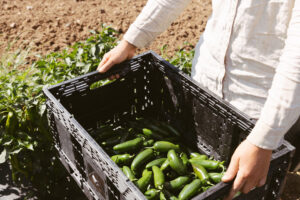 Currently, PVCF supports twelve farm operations — chicken and beef ranchers, goat milk and cheese producers, and vegetable and flower farmers — across 350 acres of land. The city has historically leased natural areas to more traditional hay and wheat operations, but small-scale farmers and ranchers have very different infrastructure needs, such as high tunnels and irrigation ponds. Because agriculture is only one part of the city’s Natural Area Department’s mission, there are some specific ecosystem needs that require farmers to modify their practices. Stacy Lischka, the organization’s executive director, acts as a go-between for city staff and farmers on issues like infrastructure development, irrigation, and ecosystem protections. Without PVCF as a single point of contact, city staff and farmers alike would be overwhelmed by the work of communication and negotiation inherent in supporting such a wide variety of producers. The success of the project depends on the efficiency PVCF adds to the process.
At Flores Del Sol, for example, Val Sumner of NoCo Cattle Company has modified her already sustainable practices to protect nesting birds on the site. PVCF worked with city staff to address Sumner’s concern about possible loss of income and to develop a process by which local volunteers mark the nest sites each spring. Sumner, in turn, staggers her mowing and grazing schedules to avoid these areas during the nesting season. In 2024, three vegetable operations, two of which are part of a federally-funded farm accelerator program, will share irrigation and wash/pack resources at Flores Del Sol, which reduces the footprint of each individual farm on the land. The farm operations co-exist with the wilder natural area spaces to sequester carbon, reduce water usage, preserve habitat for birds and pollinators, and provide beauty in the community. These healthy ecosystems, which mitigate the effects of climate change, would disappear if the land was developed for residential or commercial purposes.
This first-of-its-kind work requires constant re-evaluation and nimble adaptation. In 2023, in the face of ever-increasing land prices, PVCF voted to shift from its original for-profit cooperative model to a 501(c)(3) nonprofit to maximize the organization’s fundraising capacity. While purchasing and conserving land remains a possibility, collaborations with government agencies like the City of Fort Collins and private landowners have proven to allow the group to best serve its mission. The organization is actively working to expand the amount of land it manages and the number of farmers it can support, while also working to educate the community about the benefits of local agriculture in bringing people together and mitigating climate change.
Most importantly, the land PVCF leases and manages is less likely to turn over than privately owned farmland, which retiring farmers often have no choice but to sell to developers. For Native Hill Farm, the hope is that the partnership at Kestrel Fields will continue in perpetuity, so that when Koontz and Slota are ready to retire, a young farmer can take over the operation and continue to produce organic food for the community. Kristin Maxwell, owner of Cabri Creamery, a producer at the Pryor Farm site, highlights this as well. “At PVCF, there are lots of people working together toward this one goal of farm preservation and land access to sustain the future for a next generation of farmers.”
Even as PVCF works to expand into partnerships with other municipalities and individual landowners, Lischka acknowledges the difficulty of the work. Without existing models, the collaboration takes flexibility and communication from all parties involved — city officials, farmers, board members, and donors, among others. It can be time-consuming and complicated, but after eight successful years, the organization hopes to be a model for other communities with the same commitment to farmland preservation and conservation agriculture.