

Color Crafting
By Kate Mannix, photos by Ashlee Ophus
Originally published in Resilience, Issue #46 – Colors of Home

The hues of fall are my favorite. Montana doesn’t have the showgirl qualities of a New England autumn, no flaming hills of hardwoods. There are a few exceptions: larch pretends to be just another evergreen until late October, when she suddenly springs forth and performs her Opry to great effect. And aspen will always belong on the stage, her quivering leaves dancing their way to the forest floor.
But for most of this territory, forests are merely a backdrop canvas, an ebony emerald rising above the predominating ecosystem. The true lords of this land are grass and sagebrush.
Dryland grasses make no performance of their hibernation ritual. Their only moment of flash comes for a brief period in spring, when they participate in the boastful green-up of the growing season. By the time the balers are click-click-clicking away in the irrigated meadows, they return to their humble hues — the penetrating beige of the West.
And then, as the inevitable smoke clears in September, the sun lowers in the sky and the stage manager directs a new spotlight upon the sagebrush hills. What was once the impoverished brown of late summer transforms into a rich golden canvas, painted with burgundy stems, sage leaves, and rosy seedstems, long since dispensed of their cargo.
It’s in this setting that I return to the studio, changing the patterns of my day with the shift of seasons. The rush of the harvest is over, and now it’s time to settle down and settle in. For me, this means turning to my craft.
I began experimenting with the art (and science) of coercing color from plants in 2019, after stumbling upon the work of Sara Buscaglia, a fellow Rocky Mountain agrarian and fiber artist. Her work focuses predominantly on dyeing cotton and linen for quilting. I come from a long tradition of quilters — my Grandma Ruth was an award-winning quilter and started me on the sewing machine at a young age. I have always loved the honesty of quilting; you simply cut squares and triangles, sew them together, and now a solar system’s-worth of stars are lined up in neat rows, culminating in far more than the sum of their parts.
As soon as I witnessed the hues created by plant dyes, I was hooked. My first experiments were with plants around the ranch — sagebrush, aspen and willow barks, marigolds, cosmos, and others. As I progressed, I purchased dyes from plants too wise to try to propagate in the unforgiving climate of the northern Rockies: indigo, sappanwood, cutch.
I learned to use mineral elements to shift the colors created by each dye. Iron, aluminum, and copper will all impact different dye baths in various ways. My favorite by far is iron, which tends to “sadden” hues. A dip in an iron bath will turn bright pink into dusty mauve, rich gold into sage green, and coppery rust into bear brown.
Iron baths can be prepared by soaking rusty metal in water for several days before straining the larger chunks of rust out and warming the remaining water. On a fifth-generation ranch, bits of rusty metal and forgotten tools are effectively an unlimited resource.
The year of 2020 brought many challenges, but a silver lining catalyzed by the pandemic was the transfer of courses from in-person to online. I gained hard-earned wisdom through a myriad of different courses, deepening and expanding my own experimentation and confidence. One of the courses included dyeing silk and wool fibers. Protein fibers are more eager to take botany’s hues, their expressions richer and more even. The seed of an idea was planted: what if I tried dyeing a handful of silk wild rags? I have always loved things that merge beauty and utility. The wild rag epitomizes this and also something more.
For context, let me back up. The wild rag came to me during my first winter ranching in Montana. For the first half of that winter, my imposter syndrome convinced me that I had no business wearing the iconic western rag. I was fresh off my apprenticeship with Quivira Coalition’s New Agrarian Program. A year of cowboying on the Mescalero Apache Reservation in New Mexico was under my belt, but I was no cowboy. I had only barely conceded to wearing a straw hat in New Mexico, persuaded by a genetic inclination for skin cancer and emboldened by the 100,000 acres of isolation our lease provided.
The ranch I was wintering on had five families living on it, all tried and true cowboys. I couldn’t possibly don yet another emblem of quintessential cowboyism. I’d embraced several different identities by that time. Raised as a ski bum, I experimented with bohemianism in college, and then weaseled my way into the elusive “women in timber” splinter of the forest industry. But cowboy felt like a mountain too tall to climb. I rode horses, but wasn’t a horseman. I’d tossed a rope a few times, but usually forgot to dally when I managed to catch a head.
There was one hiccup in my self-imposed abnegation: the winds of winter on the Rocky Mountain front range. Cascade, Montana is a blustery S.O.B. The wind deems it a personal challenge to redesign the topography of the snowscape, building blockades across every gravel road, and relocating feet of snow from one end of the field to the other. Creatures, including, it seemed, the newly-arrived ranch hand, must adapt to the snow falling horizontally.
The first borrowed wild rag I added to my uniform was sage green with white polka dots. Most importantly, it was silk. In my humble opinion, most things that humans try to replicate from nature make a poor imitation. Satin is no exception for silk. Satin would have been no match for the tempests generated in Canada and delivered to our little basin. Silk has been cultivated in the Yellow River Valley of Eastern China for at least 4,000 years, each silkworm producing a single, unbroken thread. Sericulture, the production of silk, was a Chinese trade secret until 500 years ago, the exportation of silkworms or their eggs an executable offense. And I would argue, for good reason — liquid gold as far as this rancher is concerned.
Once again, the practicality of the cowboys’ paraphernalia overrode my nervous system, and after the first day with silk wrapped around my neck, I became an evangelist. These days, I recommend silk rags to skiers, rafters, farmers, business women, and cowboys alike. If you leave the house in the winter, the rag is for you. If you leave in the summer, may I recommend a lighter weight silk?
The opportunity to combine these newly-discovered colors of botany with nature’s most illustrious fiber was too tempting to pass up. The results surpassed even my own expectations. As it turns out, there are no ugly hues on silk. As long as the dye is fairly even, silk will do the rest. Everyday colors become extraordinary. Fence post green, egg yolk yellow, cured hay bale gold, pussy willow bark burgundy, summer sky blue. Silk takes these hues and buffs them up, does their hair real pretty and dresses them in sequins.
I started with a batch of eight wild rags. Eight turned into twenty, and five years later, I dye hundreds of silks each year. I keep waiting for the novelty to wear off, for the anticipation of pulling the silk from the dye pot to lose its luster. It hasn’t happened yet, and I have only waded in the shallowest waters when it comes to the possibilities of botanical color alchemy. The only thing stopping me? Time and an unshakeable addiction to ranching.
Just as I balance pH in the dye bath, so must I balance the hours in a day. Those of us fortunate enough to have been born to, or found our way to, an agrarian life know that the demands on time and energy are as unyielding as they are rewarding. Everyone would love to be a rancher for just 40 hours a week, but unfortunately, that’s not the job. Instead, we wake early, tend our herds, try to keep the equipment running, and put out fires (literal and figurative), until the sun finishes her daily migration. There are few ways of life that are painted more vividly than those of a rancher. Everything is depicted in sharp relief. Decisions are hard, consequences are tangible.
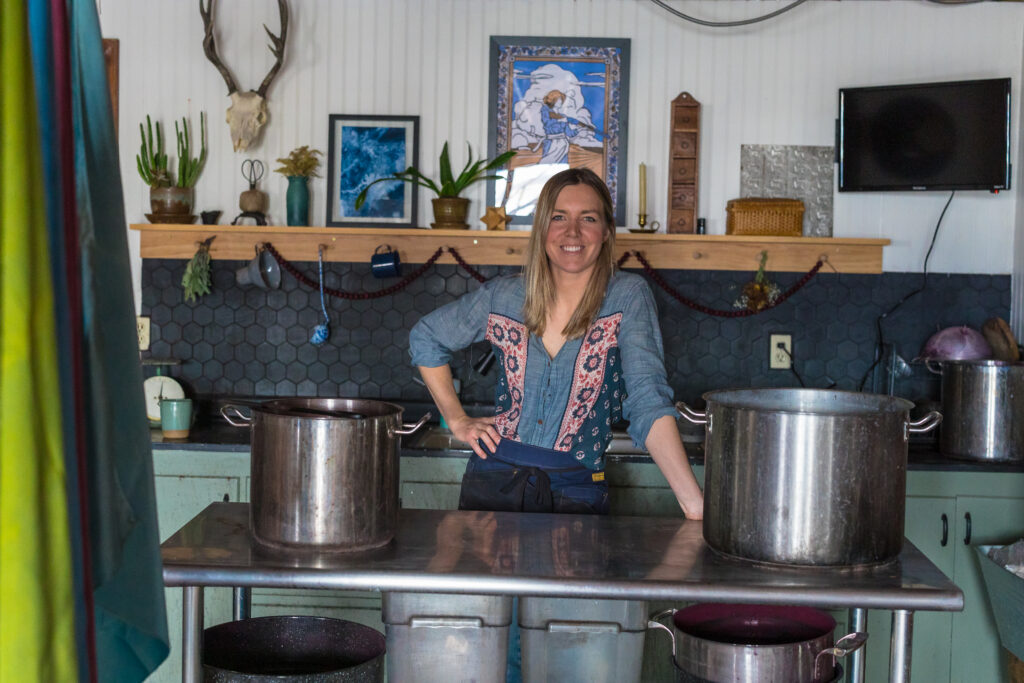
I typically dye early in the morning and late into the evening. In winter, I first stoke the wood stove that heats our downstairs, where my dye studio neighbors the plush beds of our pampered cowdogs. In the summer, I relish in the coolness of having a house built into the side of a hill, sheltered by the earth from the dry heat of July and August. It’s a year-round retreat, a place of mandatory attentiveness and creativity.
I am able to fit two large dye pots on my flat top range, so I typically work with two colors at a time. The first batch comes from a recipe, a known percentage of plant material to the weight of fiber that creates the depth of color I’m looking for. From there, it becomes an odyssey of discovery. In order to conserve water and coax every little bit of color from the plant material, I do not replace my vats. I add to them. The second and third baths are no longer a prescription, but an instinct. Sometimes I combine baths at the end, sometimes I start adding different dyestuff to discover new hues. Often colors emerge that I can’t replicate exactly, but the thrill of their outcome is added to the catalogue of new possibilities.
The process requires presence. For someone with a propensity to multi-task, the demand to sit down and keep the spoon moving in the pot is a personal form of meditation. If I lose focus, so do the dyes — their hues concentrate on one portion of the fabric and abandon others.
So I sit. I pull up my stool, pick up my wooden spoons, and tend to my craft. Wafts of madder root and marigolds rise from the pots, intermingling into an incense of earth’s bounty. Sometimes I listen to an audiobook, sometimes I give my brain the space it craves and play music. For me, to be at home and be creating is to be at peace. The meditative relief of botanical alchemy is a stone set in a tray to balance the scales against the frenzy of ranching. It lets me take the hues of my day on the ranch and infuse them into something beautiful. Something useful.
Each wild rag is a missive, a transposition of hues from our little corner of Montana to wherever you are. You’ll have your own interpretation, your own ecological reflection by which to collate the colors of your silk. But just as the cocoon of Bombyx mori is interwoven with hundreds of other silkworms to create your wild rag, so too are we interconnected, a web of folks who value land and craft and finding our sense of place within our ecosystem, instead of aside from it.
These days, I wear all sorts of hats. Some of those hats are literal: the dirt-stained straw brim, the always-expanding collection of baseball caps, the wool beanie. Others are less tangible. But the thread through it all is creativity, embodied by the silk rag that I tie around my neck each morning. A bit of art to take with me through my day. A mirror held up to the landscape around me, but infinitely easier to fold into an envelope and ship across the world.