

Belonging in Queerness
Hannah Breckbill
Photos by Rory Photography
Originally published in Resilience, Issue #45 – Searching for Home Ground
I am a first-generation farmer, on land where my family has no history. I grew up in a city, Lincoln, Nebraska, raised by parents who had grown up in Ohio, Indiana, and Iowa. As a kid I spent most of my time indoors, reading books and writing stories. Although I learned about the Salt Creek Tiger Beetle — a critically endangered insect that lives only in a creek bed on the north side of Lincoln — and the sod houses of the pioneers, and absorbed a somatic appreciation of wide skies and unbroken winds, otherwise, the specificity of place was not given much attention.
The idea of “home” was ungrounded.
Home, instead, was in people, in community.
My family is Mennonite, a pacifist Christian denomination, many of whom share ethnic identities. When Mennonites meet each other, there’s usually an exchange of questioning: Do you know this person? Are you related to this person with your same last name, or are you on a different wing of that family? We call it the Mennonite game. I’ve gone to farming conferences in other states and had strangers tell me that they know my dad, or my aunt, or my grandpa, and I’ve done the same to others. We place each other by understanding our connection to a wider, intergenerational web of culture and community.
From the Mennonite game I learned that it matters who people belong to. That if a person matters to you, then their relatives, their friends, even their colleagues must also matter. So, when I followed my college girlfriend to the rural community of Decorah, Iowa, to work on vegetable farms, I naturally wanted to place the people I met onto a map of relationship. I learned the stories of a generation or two before me; I learned who moved to town when, who was born here, what legacies they built and how their positions and relationships have changed over time. It is a sheer delight to have that mental map, that understanding of who is whom to each other, and to this place. And I think it’s true that by learning and caring about that intergenerational web of relationship and history, we can begin to belong to it.
As a queer person, though, sometimes belonging is troubled. I am lucky enough to be free of trauma around queerness — my family had been well prepared by my lesbian aunt, and I didn’t experience any loss of relationship with friends or family when I came out. But I still am hyper-aware of living in a heteronormative society, and of being engaged in an agriculture system where the idea of a “family farm” is promoted regularly despite having a particular weight and set of meanings that my queerness is not included in, let alone the fact that I’m a first-generation farmer.
Don’t get me wrong — I love the vision that is conjured with the words “family farm,” a landscape dotted with small, independent, diversified farms where people of many ages live and work. Many of us have ancestral memories of this kind of rural place. But that vision is hardly a reality these days; the ideal of an independent family farm is largely imagined, and simply doesn’t match economic reality when most farmland is run by tenant farmers.
Many queer people are not particularly fond of the term “family farm,” given that we are excluded or forgotten in many conceptions of family. But in queerness, there is a superpower: when we aren’t given a place in a system, we get to create our own systems. For example, when queer people are ostracized by their blood families, they may create chosen families, groups of people who are committed to supporting each other as families do.
So what happens when we apply the queer superpower to land ownership and stewardship? Let me share the story of my farm.
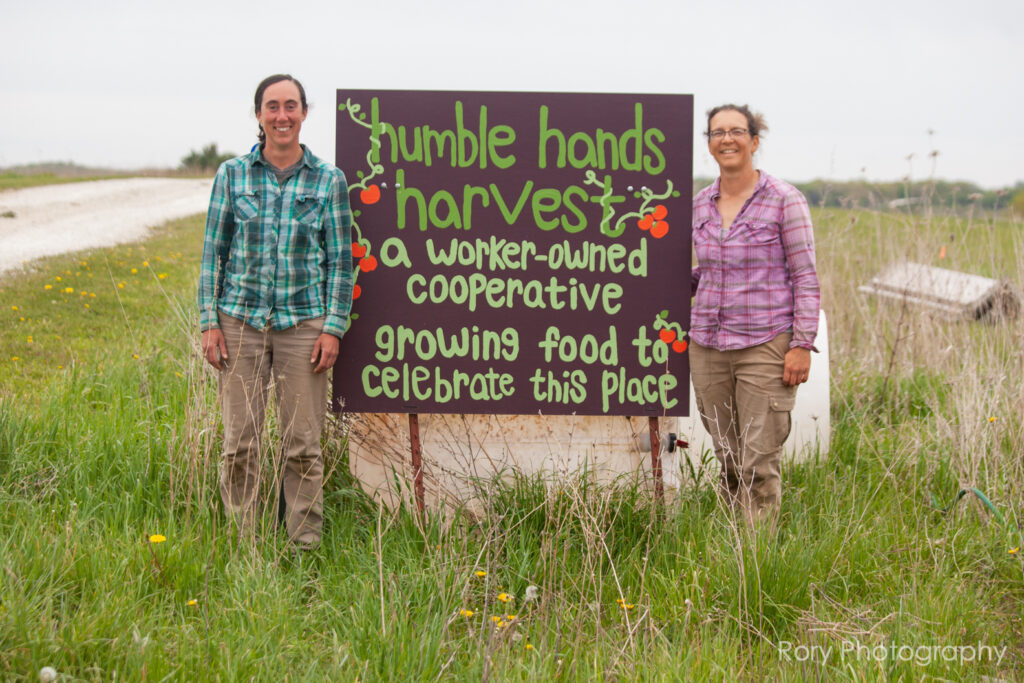
Nowadays, Humble Hands Harvest is a worker-owned cooperative farm that employs four to five people during the growing season who raise two acres of vegetables for direct market sale; we’re also planting fruit and nut trees into 20 acres of sheep pasture.
Eight years ago, though, the land that we’re on was undeveloped hay ground, recently having come off of decades of corn on corn. A group of about 20 neighbors had pooled their money and bought the land to prevent it from going to auction, fearing what might happen to the neighborhood if a hog confinement operator bought the land. All across Iowa, livestock have been removed from the landscape, and instead, are confined in feedlots and buildings. The land that they once grazed — and which before that was a diverse, indigenously-managed prairie with deep, rich topsoils — is tilled and mono-cropped in corn and soybeans, eroding into the Gulf of Mexico and bringing nitrates with it. Our neighbors used their collective power to protect one small piece of land from that kind of use.
I, a single, queer farmer, had been renting land in the neighborhood, building up a market vegetable business, and was becoming increasingly disillusioned. Farming by myself didn’t feel sustainable, and neither did farming on land that I leased year-to-year. I couldn’t invest in infrastructure or soil building in the way that would make sense in a longer-term arrangement. Bur farmland ownership is nearly impossible to access for people who are not coming in with considerable wealth. Farmland in Iowa costs an average of $11,835 an acre, so cash-flowing a mortgage on farmland requires significant production and profitability from the get-go – or continual investment of outside income. Neither of these options is easy to come by for a beginning farmer, especially one trying to farm full-time like me. According to the USDA, most of the household income of farming families is generated by off-farm jobs.
I was one of the co-owners of the hayfield, and the spot seemed just right for a small, diversified farm. But I couldn’t imagine managing the farm by myself, let alone financing a land purchase. I spent a year or so dreaming of intentional community (another term, perhaps, for chosen family) with a group of people before realizing that if the farm was to keep going in the short term, I needed a co-farmer. I invited Emily Fagan, a farmworker new to the area, to join me in the farm business, and I went about arranging with each co-owner of the hayfield how I might access their share of the land. By the spring of 2017, I had purchased or been gifted ownership of eight acres of the hayfield, and had an arrangement to rent the other 14 acres. We raised funds to bring electricity to the farm and dig a well, put up a deer fence and a greenhouse, and built a yurt that I moved into. Wha-bam! A long-term farm home was started.
Emily and I ended up working well together, have developed Humble Hands Harvest into a worker-owned co-operative, and finished buying the entirety of the collectively-owned land. Even though the kind of production we do is what people might imagine when they think “family farm,” we are not a family farm at all: we have an on-boarding and off-boarding process for worker owners that will allow the farm to continue beyond any one farmer’s tenure there, and that passes the equity of the farm to the workers rather than heirs; we have committed, through an internal financial structure that we call the Commons, not to hoard the wealth of our farm that we accessed with community support; some workers live on the farm and some do not, as we each prefer. We are a queer farm.
••••
 Nevertheless, we still live in a heteronormative culture. For me, it is alienating and isolating when coupling up and establishing nuclear families is The Way that is expected, celebrated, and supported. I feel invisibilized in the constellation of relationships that constitutes belonging when my social circles are saturated with straight expectations.
I was feeling that kind of lonely once when I called a friend about it. They told me that I needed more queer people in my life, and that so many queer people want what I have been building. We want to connect to each other and to the land; we want to work with our bodies, hearts, and minds; some of us even want to make life together intentionally. So, we decided to host a gathering at Humble Hands Harvest that would draw in people who shared these longings. That was the birth of the Queer Farmer Convergences, which led to the Queer Farmer Network.
Convening a gathering is one of my favorite things: it invites belonging in a way that nothing else does. When I express a clear vision for what will happen when we gather, I know that the people who accept the invitation are going to support that vision. And so the Queer Farmer Convergences that I have hosted have always been about belonging. No one is not queer enough, no one is not farmer enough. If you are called to come, you are precisely who we need.
A Queer Farmer Convergence is made of many physical details: tents for all to camp on the host farm; meals, both potluck style and catered, always featuring local ingredients; workshops, with topics and hosts sourced from the attendees, about seed saving or natural dyes or meditations on oak savannas or farmworker organizing; a dance party.
The most meaningful parts of a Queer Farmer Convergence are usually less planned, and more about the magic that happens when people are together and able to attune to each other’s energy. We have kept gatherings to a size where everyone can be in a circle, seen and heard. We facilitate small group connection and conversation. We allow for lots of spaciousness between scheduled activities. We even hold a variety show that gives everyone a chance to show their stuff — singing, dancing, drag, poetry, maybe even an arm-wrestling tournament. People come away from a Queer Farmer Convergence energized and affirmed, seen and held. Sometimes they come away with new professional connections or friendships…and yes, there have even been romantic relationships that have emerged.
As we have held Queer Farmer Convergences over the past five years, there has been a community developing, a network of comrades that is sparked by in-person gatherings and continues through connections online. In the past couple years, we started a website and even came upon some grant funding for administration. So, from that initial seed of one person feeling isolated in a heteronormative world, a whole team of queer farmers has built an infrastructure for belonging: a directory of farms, a job board, a listserv, and an Instagram page where we all can connect.
••••
Early on, when I was farming by myself at Humble Hands Harvest, I participated in a nature-connection activity in which we were guided to walk in the woods for a few minutes and find something, anything, that we were drawn to. We were instructed to sit with what we found, observe it, and come up with a description of what we liked about it, before we returned to the rest of the group.
I wandered through the woods. As a vegetable farmer, I’m often drawn to look at what’s growing on the ground, but this time I cast my attention to the trees, and soon came upon an oak, bigger than everyone else, with nicely curved branches. I thought about how strong those branches were and how deeply connected they were to the main trunk. As I circled the tree, I noticed that at the bottom, between some roots, was a hole that some creature was living in, having left nut shells around the entrance to the hole. And that was it: I saw the tree as a home, not only to a squirrel, but to birds, insects, to all the plants growing under its canopy. The tree expressed hospitality, simply by rooting down and growing, by being its best self. It fed the beings around it, it sheltered them, it gave them beauty and structure.
When we came back to the group, the leader asked us to share what we found in the woods, and say, “I like x because…” And then, she had us replace x with “myself.” This meant that I found myself saying that I like myself because of the hospitality that I can give simply by growing into my own place in the world. I like myself because of the home that I can become by sharing openly.
I think about the key roles that each of us, each being, plays in our community. The oak provides structure and nourishment; the bee pollinates; the moss soaks up excess moisture and generates oxygen; the squirrel plants the next generation and enlivens the forest with its acrobatics. And I, with the great fortune of long-term land access for my farm, get to play the role of the oak, cultivating space for a whole community to belong to. Meanwhile I rely on the contributions of everyone else for my offering to feel worthwhile — each attendee of a Queer Farmer Convergence matters as much to the whole as I do. Each person who chooses to eat the food that we grow at Humble Hands Harvest is contributing to the success of our business, and their participation in the local food system is supported by their jobs, the people they share meals with, their unique place in the fabric of community.
By establishing a diversified farm in the middle of the Iowa corn-and-soy landscape, we created an oasis, not only for ourselves, not just for queer farmers, and not just for the people who eat the food we grow, but also for non-human life. Migratory bird species that rely on grasslands to hatch their eggs found this patch of ground within a couple years of us farming here. Now every spring we’re delighted to hear the lilting whistle of the meadowlark and the chaotic chattering of bobolinks. They have found home ground with us, and they, in reciprocity, give us a belonging to the world.
To connect to the Queer Farmer Network: queerfarmernetwork.org