

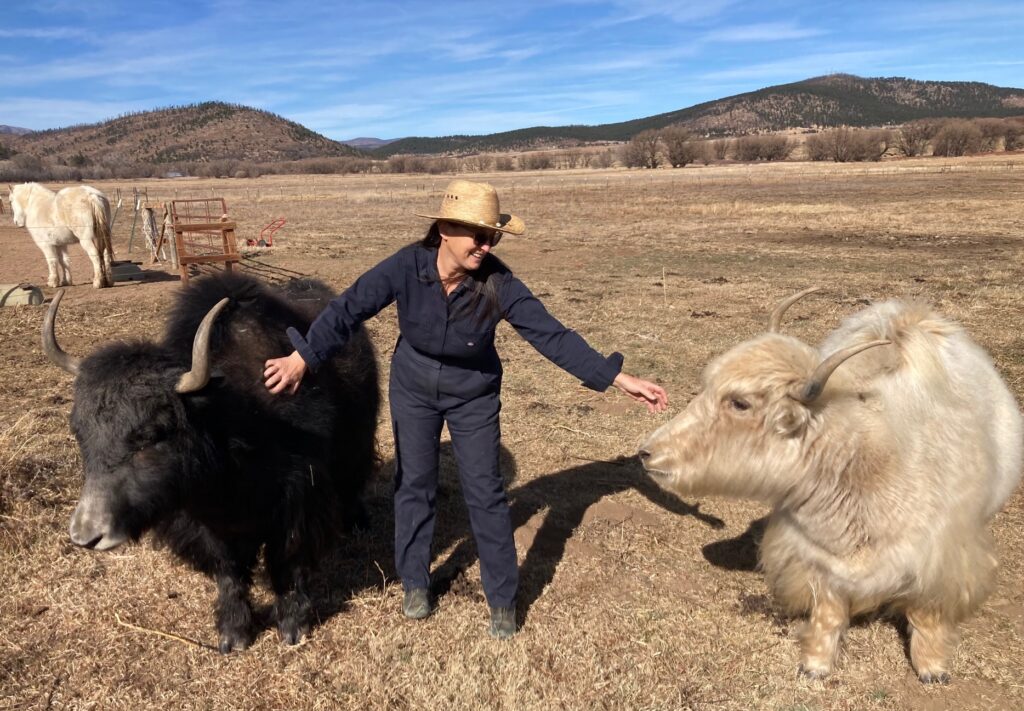
Kristin Swoszowski-Tran owns Ledoux Grange, an organic-certified, diversified produce and research farm high in the mountains of Mora, New Mexico, also raising yak. A multiple grant recipient, she explores novel methods and is a dedicated producer for local food and regenerative agriculture. Kristin is a member of the Southwest Grain Collaborative who grows/trials grains, pulses and landrace seeds.
Listen to their stories below.
For her crops to thrive in a harsh climate, farmer Kristin Swoszowski-Tran needed infrastructure to protect her grains, tomato plants, and pulses from the 65 mph winds that rip through her valley. With the help of an Environmental Quality Incentive Program (EQIP) grant, Swoszowski-Tran was able to afford premium-grade steel and covering for a high tunnel that has stood the test of time.
At 7,400 feet in elevation, LeDoux Grange, an organic-certified vegetable farm outside of Mora, New Mexico, faces cold temperatures. In this segment, farmer Kristin Swoszowski-Tran shares how installing a high-tunnel, partially funded by an Environmental Quality Incentive Program (EQIP) grant, allows her to start her growing season early, and end late.
At LeDoux Grange, an organic-certified, diversified vegetable farm in the mountains of Mora County, New Mexico, beneficial pollinators like honey bees, hover flys, and lady bugs get to forage for longer thanks to a high tunnel. During the margins of the growing season, when nothing outside is flowering, Farmer Kristin Swoszowski-Tran leaves the doors to her high tunnel open. The tunnel, funded through an Environmental Quality Incentive Program (EQIP) grant allows LeDoux Grange’s tiny, winged-residents to forage on the pollen and nectar-producing plants.